EPOXY
ADHESIVE Goo - Goop GLUE
EPOXY-ONLY WEB SEARCH
The Epoxy Glue
("Goo or Goop")/ Epoxy Adhesive Resin Page Comments From The Experts
Epoxies can make very good glues
(goo) , but the user needs
to know a few things about epoxy glue..
PRIMARY
STORE LINK ---
TOP SELLING PRODUCTS
--- EPOXY GURU HELP SITE ---
ALUTHANE MCU PAINT
---
BASIC NO BLUSH (MARINE AND
STONE EPOXY) --- BUY NO BLUSH
You won't learn if you don't
ask! We share information 24/7 and earn your business!
Epoxy Glue Resins - Goo - Adhesive - 3rd party comments
feedback
Learn about epoxy bonding and gluing - Epoxy glue
Your Host and Tour Guide:
Paul Oman, MS, MBA - Progressive Epoxy Polymers,
Inc. (floor epoxies,
marine epoxies, underwater epoxies, repair epoxies)
Member: NACE (National Assoc. of
Corrosion Engineers), SSPC (Soc. of Protective Coatings)
Board member:
Friends of the Suncook River
- 501(c)(3) non profit ----- Founder: Friday
Night Paddlers .
"Professionals helping Professionals
since 1994"
PROGRESSIVE EPOXY
POLYMERS, INC.
CALL 603-435-7199 (or
email).
We are the only
technology based coating/epoxy/resin company that actively encourages your phone
calls, not just during our East Coast work hours but also after/before hours,
evening, weekends and even holidays. We're available when you are. We form a
personal relationship with our customers and freely share technical information,
how to-advice, product information and tips-and-tricks. Speak with a
non-salesman technical professional with over 25 years of experience in the
resin/coating/epoxy industry (no newbie staffer on the phone lines!). Floors,
tables, boats, leaks, rot repair. We handle it all!
We are an 'always available,'
one-on-one, technical/scientific, coating company (watch
our video). We are NOT one of those fluffy/slick mass sales firms the
dominate the internet selling cheap third party (made in China???), low end
epoxies and coatings with no real knowledge of what they are selling and
quotas to sell to as many people as possible. 603-435-7199 (east coast time).
|
PAGE AND SITE
NAVIGATION |
Marine Epoxy Links Page ====> Part #3 Sub-Page ====> This 'Linked To' Sub-Page
and Epoxy Repair Links Page ====> This 'Linked
To' Sub-Page
"epoxy adhesive - epoxy glue"
FYI: catalog pages are blue (marine) or yellow (home/indust), info pages are green,
product pages are purple, core pages are gray
No Sales Tax applied. Save Money, you're shopping
in Tax Free New Hampshire
|
NOTICE: Legal notices, Terms of Service, warranty information, disclaimers, health warnings,
etc. are required reading before using website, ordering and/or using Products. Any such use and/or ordering, online
or by telephone, shall constitute acceptance and knowledge of all such terms.
CLICK HERE (www.epoxyproducts.com/legal.html) to access these terms. |
MEMBER:
Internet Epoxy Confederation (IEC -
CLICK HERE TO VISIT) -- "Where Professionalism Still Matters"
We've been selling epoxy - marine epoxy (boat building - wood / fiberglass
repair) industrial coatings - garage paint -
underwater epoxies - thick
putties - tabletop resins and supplies since the early 1990's
|
2 Part Resin
Vendor Comments
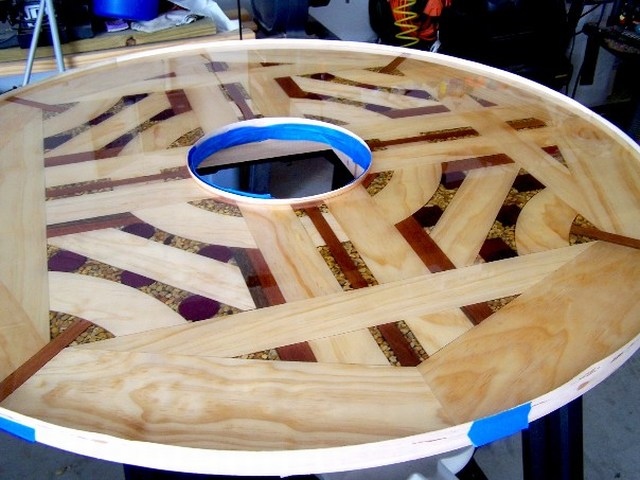
Epoxies can make very good glues
(goo) , but the user needs
to know a few things...
What makes a good glue? Generally a product thick enough to hang on a vertical surface and not to 'run off' level
surfaces. If it has some flex/give, that is a good thing too - surfaces can expand, contract etc. Of course, it
should also be waterproof.
Epoxies come in many thicknesses, and different amount
of flexing. That said, epoxy glue, say to bond two pieces of wood together, are often just 'regular' epoxy (often
the 'marine' epoxy used by boat builders) with thickeners mixed in to make them into a paste or gel. Sometimes the
user will first coat the surfaces with unthinned epoxy and then apply the thickened epoxy.
One word of warning when gluing with epoxies. Epoxy
glue joints failure is almost always the result of over clamping. Too much clamp pressure and all the epoxy can
be squeezed out of the joint. So, unlike most other glues, don't over clamp when using epoxy as a glue.
Epoxy "glues" - sometimes called "epoxy goo (epoxy goop)', offered by Progressive epoxy polymers:
1) folks often add any of our thickeners to whatever
Progressive Epoxy they are using or have on hand.
2) our Kelvar (tm) thickened WET DRY 700 will produce a rock hard chunk of epoxy that can be drilled or sanded.
It can even be applied underwater. I recently repaired an old rocking chair that went to pieces when I sat in
it.
BUY
WET DRY 700 NOW
Find these products (epoxy glue/goo) in our residential/commercial catalog: CLICK HERE
This product is a Progressive Epoxy
Polymers, Inc. best selling, favorite product. Visit our FAVORITES - 7
EPOXIES THAT WILL FIX ANYTHING web page
at:
epoxyproducts.com/favorites4u.html View other popular one-of-a-kind
products.
We really appreciate
you visiting PROGRESSIVE EPOXY POLYMERS, INC. and our web site:
EPOXYPRODUCTS.COM. Take advantage of the CONTACT links on this page to ask
questions about our products and/or your projects. You can stay in touch with us
via our NEWSLETTER (link on our
contact page) which is
emailed every 6-8 weeks.
This
current page is all about:
EPOXY
GLUE ADHESIVE
Epoxy Glue Resins - Goo - Adhesive - 3rd party comments
feedback
Learn about epoxy bonding and gluing - Epoxy glue
|
 |
WOW!
35%
- 40% of all daily online or telephone orders are from existing
customers. That's an amazing 'REPEAT
CUSTOMER" number. |
|
EPOXY-ONLY WEB SEARCH
|
603 - 435 -
7199 ANYTIME 24/7 FOR HELP OR ORDERS |
|
 |
|
The following text is from a series
of emails I had with one of our epoxy customers. Obviously he's an expert craftsman. His comments are great and
his views of gluing and epoxy as a glue (compared to a coating) are insightful.
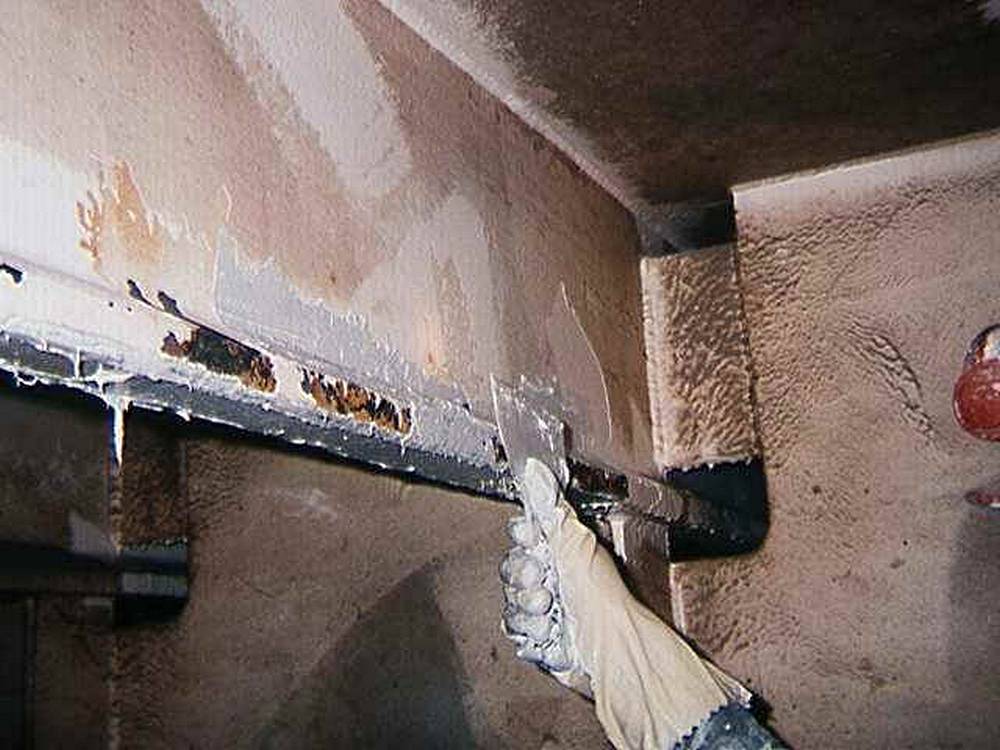
Back in the good old days when people that built things like furniture and boats and houses actually knew what
they were doing, they would pick wood according to the grain so that the expansion and contraction would all work
together as a system. If it was going to warp, it would warp upwards against gravity or backwards against the cement.
Wood making up a panel was cut so it would warp left/right instead of up/down. Certain joints were glued, others
pinned, others left floating to allow for movement. They knew the difference between a nail or a staple or a screw
or a dowel and how they held or didn't hold. Those days are gone.
Today everything is either made of particle board, plywood or butcher block so that all those forces cancel out
and they just ASSUME that the shear strength of the glue is sufficient to hold the piece together long enough for
you to get bored with it and throw it in the garbage.
When you see a piece of furniture split at the seams, this is what has happened. The expansion due to moisture
or temperature has exceeded the shear strength of the adhesive and it splits. If the shear strength of the glue
was stronger, it would warp like a pretzel.
The other way to minimizing this is either aging and stabilizing the wood before it's final milling and shaping
(which doesn't happen any more) or using regional wood which has stabilized over time for a particular area (which
also doesn't happen anymore).
Along with matching the hardness of the glue to the material and chemical compatibility of the glue to the surface,
there is also glue joint "design." Simply optimizing the amount of surface area that the glue is grabbing
upon (because these forces are measured in psi) surface area is the easiest to adjust.
Roughing up a surface not only allows the glue to penetrate (in the case of a porous surface) but also increases
the effective surface area by several percent. The more abraded and the cleaner it is, the higher percentage of
the available area the glue can actually adhere to. Preparation is everything.
You know those joints...they break and you can see the glue was only sticking to 50 percent of the area? That happens
on a microscopic level too. If the surface isn't prepped properly or a filler isn't used to fill in the gaps, you
end up with only a percentage of the molecules grabbing the surface. It's like velcro: the harder you push it together
and knead it, the more hooks that grab, and the harder it is to pull apart. This is exactly what is happening at
the joint-glue interface.
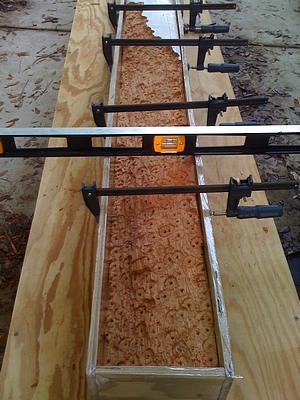
clamp, but not too tightly!
Say you have a mortise and tenon joint or some half-assed lap joint that doesn't quite fit (like most joints).
If there is any flex to the adhesive at all the joint will cam sideways (we're only talking a few thousandths of
an inch) and you will have 100% of the compression and 100% of the tension on only two points each. This is the
point where it will fail at. It will break a little more each time until there is only half the bond, then you
end up with more tension at one point than the wood can handle and the whole thing shatters. You've seen a million
of them at antique shows, whole joints shattered with half the part sticking to the leg and the other half sticking
to the original part. These are all from faulty glue joints or the wrong glue.
We don't see it happening in day to day life because this "breakage" may only be a few wood fibers at
a time, a few molecular bonds at a time weakened. It may take a couple years to break, but it WILL break or at
least come loose, 100% guaranteed.
Converse to what one would think, a rigid glue spreads the tension out over the whole area. It essentially fills
in the space between the surfaces and makes the perfect fit. This is why epoxy -- by itself -- is a "bad"
adhesive. It IS rigid but It's meant to glue one thing to another thing, not itself, and is optimal only over a
few thousandths of an inch gap.
Any bigger gap than that and you have to use a solid filler the epoxy can bond to (wood dust or cellulose fibers)
so that what you are essentially doing is creating a "chain" of atomic level insanely strong bonds from
one surface to the other ---- surface-glue-filler-glue-filler-glue-filler-glue-surface....
Even if the surfaces suck and are somewhat dirty you end up with a perfect mechanical match between the two that
is about as stable as a nut on a bolt.
With two heavily abraded surfaces and filler, you will get a joint or bond with epoxy that is not only stronger
than the surfaces, but so strong you could run the joint over with a steam roller and the only thing left would
be the joint.
Epoxies are great glues, the best, for certain things. As far as the soaking in goes, all parts must be abraded
heavily, clean, un-coated, degreased, and the adhesive should be allowed to sit on the surface for a minute or
so before joining them. This is the primary reason why yellow and white glues fail, they are assembled too quickly
and the water all leaches out of the glue leaving
a "starved" bond.
The problem is not that they don't sink in, they are thick and don't bond to "themselves" as well as
something else. A filler must be used. I glue nothing at all without using some kind of filler. The only thing
I use straight epoxy on is porcelain or broken pottery because there the joint is only a few microns "wide."
What's nice about epoxy is that it doesn't cure by evaporation of solvents or absorption of oxygen and moisture
like Polyurethanes and silicone...thus they can be used for large flat surfaces and lap joints.
Carpenters glue and construction adhesive bond to cellulose in the wood, both mechanically and on the atomic level...but
they flex. Great for paneling or a motif glued on a door where there isn't going to be more than a few hundred
psi tension, not a small joint.
Epoxy also bonds mechanically and chemically and atomically to a lot of things, that is why it works so well.
I got in an argument years ago with someone when I explained the prepping I
used when I glue something. The surface is abraded thoroughly with virgin sandpaper or a good sharp cutting tool;
the dust blown off (not vacuumed or wiped); washed with solvent to remove grease; detergent or ammonia and water
to remove water soluble contaminants; water to remove the detergent residue; and then alcohol to remove the water.
(This isn't necessary with wood as the abrading process exposes virgin wood underneath.)
His attitude was that is was total overkill and a waste of his time. (I suppose it's a matter of ethics for me.)
All that being said...
I tend to think that the best use for a flexible adhesive is not when one is dealing with expansions and contractions
-- because the forces involved there are far beyond ANY method of mechanical connection -- but big differences
in the actual hardness of the two surfaces: Tile to wood, metal to wood, cloth to metal, leather to wood, etc.
Again, the thing that is cool about epoxy compared to every other "glue" out there is it doesn't need
air or moisture to cure. As soon as you start dealing with a bigger or sealed in surface where the oxygen can't
get in, most glues won't dry.
Even in the case of something that is subjected to extreme shock, you don't want the glue to be soft enough to
allow the joint to move: just soft enough to not crack from the shock. Maybe shore 60D as opposed to 80-90D (where
a lot of laminating epoxies fall at room temperature).
|
ONLINE PRODUCT
CATALOGS
PROGRESSIVE EPOXY
POLYMERS, Inc
|
A COMMERCIAL - INDUSTRIAL -
PROFESSIONAL PRODUCT |
|
You won't find these products, or products like it, in
a general purpose, mass market, consumer, DIY, box store or flashy
marketing company website.
|
|
|
|
ONLINE STORE
Purchase Here ------ or CALL 603 435 7199 ------
HOME
PAGE |
|
|
Marine Catalog |
|
* home
page of marine catalog section (blue background)
* table
of contents page for marine catalog section
|
|
Section One MARINE - CLEAR EPOXIES
Section Two FILLERS THICKENERS ADDITIVES
Section Three THICKENED EPOXIES - EPOXY PUTTIES, ETC.
Section Four EPOXY PAINTS (barrier coats)
Section Five URETHANES AND NON-EPOXY COATINGS
Section Six NON-SKID DECK COATINGS
Section Seven MARINE REPAIR PRODUCTS
Section Eight MISC. MARINE PRODUCTS |
|
|
MASSIVE BOAT HOW TO
- ISSUES -
HELP WEB LINK SITE |
|
| |
|
|
Residential /
Commercial / DIY Catalog |
|
* home
page of residential/commercial catalog section (brown background)
* table
of contents page for residential/commercial catalog section
|
|
Section A EPOXY PAINTS
Section B FLOOR EPOXIES (regular and non-skid products), SEALERS, ACCESSORIES
Section C THICKENED EPOXIES - EPOXY PUTTIES, ETC.
Section D CLEAR EPOXIES
Section E NON-EPOXY PAINTS COATINGS SEALERS
Section F MIX-IN ADDITIVES
Section G OTHER PRODUCTS
Section H SURFACE PREPARATION PRODUCTS
Section I MISC. ACCESSORIES |
|
|
WEB
EPOXY
FLOOR ISSUES LINKS SITE --- WEB
EPOXY
REPAIR LINKS SITE |
|
|
PRODUCT
DATA SHEETS -------
BY SUBJECT
INDEX HELP SITE |
|
|
top selling favorite
products for your every need
Buy
Talk Chat Support
EMAIL
or
603 435 7199
|
Let's stay connected.
It's a win-win situation. Receive
our online NEWSLETTER by
emailing us your name and email
address. |
American manufactured, distributed, and sold epoxies and
coatings.
Your business helps small
American Family Businesses - Thank You! |
|
|
PRODUCT SPOTLIGHT: |
|
Wet Dry 700 Epoxy
Ultimate Repair Epoxy
Paste
Above and below the
Waterline
Like Nothing You
Have Ever Worked With Before!
Need to fix, glue, patch, fill, bond,
coat or cover something underwater? Need
to reinforce/wrap corroded, damaged or
leaking pipes (with epoxy and fiberglass
cloth)? Need to do a fiberglass cloth
and epoxy repair with a non sagging
epoxy paste? (even underwater?). How
about sealing electrical connections in
a ‘glob’ of waterproof epoxy? Patching
some wood rot? One of our customers
repaired serious rot in an 100 year old
marine railway submerged under 12 feet
of water.
Wet Dry 700 has saved sinking boats
(and sunk boats - read Escape From
Hermit Island available at Amazon.com.
The authors recommend you don’t leave
your dock without this epoxy - see
epoxyproducts.com/cs_boat.html). It
is also used on leaking pools and
corroding barge mounted floating homes.
Welcome to the world of Wet Dry 700
(tm) Epoxy
Wet Dry 700 (tm) epoxy paste is a
leading example of consumer driven epoxy
technology, resulting in a versatile,
field friendly repair product for
difficult environments. Wet Dry is a
solvent free, high performance epoxy
reinforced with kevlar (tm) pulp and
feldspar/ceramic. It can be applied to
wet, damp, or dry surfaces.
Wet Dry 700 looks a bit like joint
compound (dry wall mud), or cake icing
with a simple 1 to 1 mix ratio that you
can ‘eyeball’. A scoop of Part A and an
equal scoop of Part B and you are ready
to go.
This is one of our top selling
epoxies. People first buy it for a
specific project and then generally buy
more just to have on hand. |
|
"I cannot believe how incredible this
Wet Dry 700 is. It's revolutionary.
The original repair to my storm shelter
would have lasted years if the shelter
would just shifting around in the
ground. DON'T STOP SELLING THIS STUFF!"
Jeff 1/2013
( 10/2013)
Comments: Returning - Underwater
repair
"My third or
fourth order and am still quite pleased
with the result. It has many uses above
and below the water line"
|
|
Another Amazing Product
- ALUTHANE
aluminum Moisture Cured Urethane Coating
- corrosion fighting, heat reflecting,
temperature resistant sealer, primer,
top coat. Use on wood, metal,
fiberglass, cement.
READ MORE |
|
PROGRESSIVE EPOXY POLYMERS, INC - 603 -
435 - 7199
Amazing Products - Amazing Support
(see
our home page CLICK HERE) |
|
data sheets and msds and SDS sheets
at
epoxyproducts.com/datamsds.html |
This product is a Progressive Epoxy
Polymers, Inc. best selling, favorite product. Visit our FAVORITES - 7
EPOXIES THAT WILL FIX ANYTHING web page
at:
epoxyproducts.com/favorites4u.html View other popular one-of-a-kind
products.
ON-LINE
CATALOG HOMEPAGE.
Inside Our non-marine, commercial, DIY Catalog:
corro coat FC 2100; water gard 300; CM 15; crack coat™;
liqua tile 1172 potable water; water prime
Find Corro Coat FC
2100 and Water Gard 300 epoxy in our Best Selling - fix anything
Catalog
water bond (water based); industrial floor epoxy;
bio
vee seal; walnut shell; rough coat grit filled
epoxy floor paint; epoxy clear top resi
wet/dry 700; splash zone A-788, epoxy cream; splash
zone a-788
Find
Wet Dry 700 epoxy in our Best Selling - fix anything
Catalog
low V epoxy; basic no blush;
ESP
155; Bio-Clear 810; epoxy clear top resin
Find
Low V, Basic No Blush, and ES 155 epoxy in our Best Selling - fix anything
Catalog
Aluthane moisture cured urethane;
Acrylic Poly UV Plus
and other 2 part polys ;
Capt.
Tolley's creeping crack sealer; india spar varnish;
Find Aluthane in our Best Selling - fix anything
Catalog
fumed silica; fiber fill; micro
balloons/micro-spheres; graphite; wood flour; EZ thick, rock flour;
water activated pipe wrap; TA 661 solvent-free epoxy brush cleaner; fiberglass tape/cloth
short nap epoxy rollers; epoxy/stone deck resurfacing roller; 1 inch foam brushes;
2 inch bristle brushes; tongue depressors
Questions? / Phone order?
/
EMAIL / CALL 603-435-7199 EST /
BUY
ONLINE
GOOGLE SITE SEARCH - Click here
Epoxy specific site search
Click here - YouTube video.
Learn about
Progressive
Epoxy
Polymers
Inc.
EVAL4U
- how to evaluate your epoxy
vendor -
CLICK HERE -
Progressive Epoxy Polymers, Inc.
www.epoxyproducts.com

Epoxy Glue Resins - Goo - Adhesive - 3rd party comments
feedback
Learn about epoxy bonding and gluing - Epoxy glue
####