Boat Repair Hindsight -
Tips, Tricks, Rules of Thumb, etc.
CLICK HERE
Epoxy paint rollers (and more) Repairing hairline cracks in old fiberglass hulls Flexible non-skid deck surface x
.. CLICK
HERE TO GOOGLE SEARCH OUR ENTIRE WEB SITE FOR KEY TERMS/WORDS ..
We now sell short nap epoxy rollers.
Which epoxy to use? click here
This has become such a critical topic that a dedicated web page has been assigned to Penetrating Epoxies.
Click here to link to: www.epoxyproducts.com/penetrating4u.html Third party article: click here
For the finest above the waterline hull coating (white only) I would recommend
our LPU 100 - a two-part linear polyester urethane (compare to Awlgrip) over a primed surface (we also have a less
expensive white 2-part acrylic urethane now). For more information about epoxies and urethanes see our Chemistry of Epoxies/Urethanes
page. For more info about LPU 100 - CLICK HERE. We now also sell LPU 100 in clear. One idea is to paint the hull in whatever color enamel or
latex and then topcoat with the clear and durable LPU 100 clear. The LPU 100 will go on fine, but I have no data
or feedback as to how long such a system would last. A standard 3 coat industrial system (zinc primer, epoxy, poly topcoat) - click
here OR For the finest above the waterline hull coating (white only) I would recommend
our LPU 100 - a two-part linear polyester urethane (compare to Awlgrip) over a primed surface. For more information
about epoxies and urethanes see our Chemistry
of Epoxies/Urethanes page. For more info about LPU 100 - CLICK
HERE. We now also sell LPU 100 in clear. One idea is to paint the hull in whatever
color enamel or latex and then topcoat with the clear and durable LPU 100 clear. The LPU 100 will go on fine, but
I have no data or feedback as to how long such a system would last. For the finest above the waterline hull coating (white only) I would recommend
our LPU 100 - a two-part linear polyester urethane (compare to Awlgrip) over a primed surface. For more information
about epoxies and urethanes see our Chemistry
of Epoxies/Urethanes page. For more info about LPU 100 - CLICK
HERE.
We now have an entire site on this - Click Here
This Q & A was taken from the boatbuilding.com forum. It explains everything
better than I could! - paul
Mix ratios/pumps - Most epoxy disasters result form mixing mistakes.
Some epoxies have more forgiving mix tolerances. Generally the closer to a 1 to 1 mix ratio the better. In these
cases being off a tiny bit is not so serious but with mix ratios of 1:4 or 1:5 Some epoxy companies like to sell inexpensive 'pumps' to measure out units of epoxy base and cure. I think
it is more of a gimick (and money maker). I would rather measure out the epoxy in disposable paper or plastic cups
(two cups of A to one cup of B). Throw away the cups when they become 'messy' or even use new cups with every batch. The pump issue came up on the WoodenBoat boatbuilding forum (11/19/01) "Temp and Epoxy Cure."
Here's what was said about those pumps:
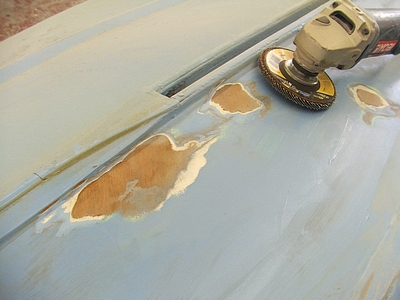
All old fiberglass hulls seem to have them - lots and lots of tiny spider web like,
gel coat cracks. These hairline cracks are ugly and can let moisture into the hull. Here's my thoughts (and tests) on how to repair: 2) coat the area with our aluthane aluminum primer. The very thin aluthane will be
drawn into the crack to help seal it and at the same time prime the surrounding fiberglass. 3) paint hull with a coat of our very brushable, 100% solids (0% VOC) Low V epoxy.
This will actually cover the cracks and vanish them under a layer of epoxy. 4) sand the epoxy/hull smooth 5) paint the hull. If using our LPU 100 polyurethane you'll need at least two coats
to cover the aluminum color of the aluthane.
Epoxy will not stick to the poly bags we wrap our epoxy cans with for shipping. Simply
apply the epoxy and evenly press the platic across the wet epoxy and wait for the epoxy to harden. Then peel off
the plastic.
This now has its own web site - Click
Here
Opinions and comments are strictly those of Paul Oman. Others will certainly disagree with at least some
of the things mentioned below.
Readers are encouraged to seek out alternative opinions and viewpoints rather then relying completely
on the information and ideas offered below.
Information/viewpoints are not 'vendor/manufacturer' official recommendations or specifications. Use
this information at your own risk!
OUR FAVORITE EPOXY PRODUCTS - CLICK HERE
TOPIC INDEX
Barrier Coatings for fiberglass, steel, and cement
Boat Blisters
Brightwork
Epoxies - How to evaluate/compare
Epoxy - How Much Epoxy do I Need?
Epoxy vs. Fiberglass (polyester) Resin
Paint and Painting - Latex Paint
Penetrating Epoxies
Rotting Wood and Ethylene Glycol
Underwater Hull Surface Area Calculations
Epoxy Coating Your Boat Hull
Which Brand of Epoxy Should You Use?

Roller Recommendations
Users recommend using a 3/16 inch nap roller specifically labeled for use with epoxies (regular rollers are
3/8 inch). An alternative would be a ‘lintless' roller. Foam rollers work also, but the foam may begin to break
off before job is complete. Regular ‘bulk' rollers will work too, but will leave roller fibers/lint on the surface
for the first 30 square feet or so.
Check out those painting 'pads' - a short nap on a foam block or plastic holder. Our tests seem to show they work
better than bushes or roller!
notes on rolling epoxies on smooth surfaces (such as hulls) click
here
Barrier Coatings for Fiberglass, Steel, and Cement Hulls
Essentially a barrier coat is simply a layer of epoxy, which is highly non-porous, applied over a rather porous
polyester resin fiberglass hull. The regular fiberglass hulls can selectively draw in water and create blisters.
The epoxy barrier coat seals the hull.
Despite what you may have read, barrier coat technology is not rocket science. It boils down applying a sealing
coat of epoxy to your hull and basically any epoxy will do the job, in fact, from what I have observed many paint/resin
companies seem to have brought obsolete and junky epoxies back to life as barrier coatings.
Nice Thing To Have In Your Barrier Coating:
1) pigment - so you can see where you've painted it and get an idea how evenly and uniformly you have been applying
it.
2) thickening and gelling agents. These two are not quite the same thing. Hopefully your barrier coat is thick
enough that you do not have to apply coat after coat to get a reasonably thick coat. How thick? No set answers,
but figure about 10 mils which would normally be about 160 square feet per gallon of a SOLVENT FREE coating. That
might equal 3 or 4 coats of ordinary varnish or interior wall paint. Thicker is better as it provides a ‘wider'
barrier to moisture migration. Barrier coat products range from 3-4 mil dry coating thickness per coat to 40 -
70 mil, Kevlar (tm) microfiber reinforced, single coat epoxy systems. These thicker coats are often used to seal
and protect cement hulls and 'rust proof' steel hulls.
Gelling agents keep the epoxy from sagging after application on a vertical surface. The opposite of gelling is
(sort of) the term self leveling. Ordinary epoxies used for boat building, repairing, etc. do not have gelling
agents in them. You can use them for barrier coating but watch for sags and expect the epoxy to flow so that the
coating near the water line will be thinner than the coating that collects down by the keel. Is this a big deal?
Probably not. More info: Click here
Boat Blisters
Most folks make a big deal over fiberglass hull blisters. They will not sink or boat and are not worth the worry
so many people give them. Consider them like teenage pimples or zits. Pop them, wash them, and medicate them (patch
them) and get on with your life. If you insist upon making a big deal about them, you can always find someone willing
to agree with you and charge you lots of money for whatever degree of ‘overkill' you are willing to pay them for.
More info: Click here
Brightwork
If your boat is like mine was, there are at least several wood surfaces that require a varnish or polyurethane
clearcoat. When living in the Gulf Coast I learned these finishes do not last long. Here is the technique we developed
using epoxy and varnish (or polyurethane). First, seal the wood with several coats of epoxy until you have a glassy
hard finish. Lightly sand the epoxy and topcoat with one or more coats of varnish or clear polyurethane. This will
provide the UV protection to the epoxy, will the epoxy protects and seals the wood. Our Floro Polymer would also
do this.
One other trick with the varnish. You can thicken it with fumed silica (often know by the Brand name Cabosil (tm))
-- so that it goes on twice as thick — two coats for the price of one!
Epoxies - How to Evaluate/Compare
Like whiskey, there are good and bad epoxies, potent epoxies and watered down epoxies. There are cheap/trashy moonshine
epoxies and performance blends. You can probably build your boat with any of them and be alright. The degree of
quality (or ease of use) is a very personal thing.....
Here are a few things you can look at to get a clue about the quality or user friendliness of your epoxy.
Blush/Amine blush - Blush is a waxy layer (sometimes visible, sometimes not) that develops on the surface of many
epoxies as they cure. It is a reaction of the curing (hardener) agent with moisture in the air. It must be washed
off or additional layers of epoxy or paint will not bond well to it. The very best epoxies do not blush and are
so indifferent to moisture that they can literally be applied underwater.
Nonyl Phenol - This is an inexpensive chemical added in small amounts to either side of a two part epoxy to produce
easy mix ratios. When added in large amounts, say more than 15%, it is a way to ‘water down the epoxy' and get
the cost down. Ask for the MSDS sheet of any epoxy you purchase and check for nonyl phenol. Nonyl is not necessarily
a completely bad thing, but a nonyl rich epoxy should not be as expensive as a non nonyl filled epoxy.
Induction Time - If you have to mix your epoxy and let it sit for some amount of time (called induction time) before
you can begin using it, you are probably dealing with a ‘cheap' epoxy.
Epoxy Crystallization - If your epoxy (part A or part B) tends to crystalize in the can over time (warming will
remelt the crystalized mass) you are probably dealing with a specialized epoxy or a ‘cheap' resin/hardener. There
are resins and curing (hardening) agents that will not crystalize. This might not be a purely price issue, but
it certainly is a ‘user friendly' issue.
MSDS - The Material Data Safety Sheet - all vendors and manufacturers are required to have these safety sheets
for each of their products. I am always surprised how difficult it is to get an MSDS from almost every Epoxy vendor.
If they will not offer up a MSDS for their base AND cure/hardener without a lot of hassle, by from a vendor that
will. MSDS information should also be available at the local marine store for all the products they carry.
Epoxy - How Much Epoxy Do I Need?
1 gallon of resin wets out:
material sq ft
.75 oz mat 64 square feet
1.5 oz mat 32 square feet
6 oz cloth 90 square feet *******
10 oz cloth 60
18 0z woven roving 40
24 oz woven roving 32
2415 bi-ply 16
******** This is a very common weight. Figure 50 square feet of coverage with 2 top coats of additional epoxy to
completely bury the cloth weave (i.e. three total coats of epoxy).
Paint and Painting - Latex
We have discovered how great exterior latex paint is on boat surfaces above the waterline and on epoxy surfaces.
A top quality semi-gloss, exterior house latex (like that used for trim or shutters at $30 per gallon) is easier
to apply, easier to clean up, keeps it shine much longer and is more fade resistant than any marine enamel I have
ever used. It is also less brittle and less subject to cracking. Being slightly porous, it resists blistering much
more than enamels. It all makes sense. Paint companies have performed a lot more R&D in the competitive, huge,
house paint market than in the much smaller marine paint niche. Another plus - with custom blending, you can get
any color you want.
Expert article on Latex on boats: click here
A second tip. Do not every use pure white paint on your boat. It shows too much dirt, etc. Instead use an off-white,
something with a slight gray or blue tint. You will find that while your off-white may look gray in the can or
at your home, when on your boat, and surrounded by other boats, it will still look pure white and much whiter and
brighter than any of the other ‘white' boats around it.
Another real plus. If you are like me and work on the boat during the weekends, this can save you an entire work
session. Latex paint can be applied to just applied, still wet, epoxy without waiting for the epoxy to even begin
to cure. This work, at least, with the non-blushing marine epoxy I use. I cannot say for certain if it works with
other, more common, name brand epoxies which do suffer from amine blush. It is nice to fill an dent or gouge with
epoxy and then immediately carefully brush or dab on the matching hull/deck latex paint instead of waiting a week
to repaint the repair.
For the finest above the waterline hull coating (white only) I would recommend our LPU
100 - a two-part linear polyester urethane (compare to Awlgrip) over a primed surface. For more information about
epoxies and urethanes see our Chemistry of
Epoxies/Urethanes page. For more info about LPU 100 - CLICK
HERE.We now also sell LPU 100 in clear. One idea is to paint the hull in whatever
color enamel or latex and then topcoat with the clear and durable LPU 100 clear. The LPU 100 will go on fine, but
I have no data or feedback as to how long such a system would last.
Penetrating Epoxies
Epoxy vs. Fiberglass (polyester) Resin
Standard fiberglass resin (polyester resin with styrene) is used to make fiberglass boats. It is inexpensive, smelly,
dissolves foam, sticks will to itself, tends to be slightly porous (can absorb water and form blisters), and does
not stick well to wood, metal or other surfaces.
Epoxies are as messy as polyester resins to work with and cost a lot more. However, they do not smell as badly,
generally will not dissolve foam, sticks great to nearly everything (except ‘milk carton' or ‘gas can' plastics),
and are much less porous than polyester resins.
For fiberglass on fiberglass repairs, you might use polyester resins, but even in those cases, and certainly for
all other situations (especially when wood is involved), use epoxy resins.
Note that all epoxies are not created equal, but even the worst of the epoxies is probably more than adequate for
about any task you might put them too.
Rotting Wood and Ethylene Glycol
I don't know why the use of Ethylene Glycol (ie. regular automotive Antifreeze) to kill and treat the fungus that
causes wood rot causes such strong reactions in many people. Obviously the best solution to rot is to cut it out
completely and replace the damaged area. If you cannot or will not do that (such as on the top surface of an otherwise
good wooden dock piling), then liberal use of antifreeze on the rotting wood will kill the fungus. The antifreeze
will evaporate, leaving begin just a slight residue. The rot fungus will eventually return - the glycol have evaporated
away. The wood is still damaged and rotted, but at least you've checked the rotting for the moment. If somehow
patched or coated/repaired the rotting will probably not continue hidden under the patch.
I cannot speak for other epoxy brands, but the non-blushing brand of epoxy I use does bond to anti-freeze coated
surfaces. I have even mixed antifreeze into the liquid epoxy and it cured just fine, although I can see no reason
for every doing this.
Underwater Surface Areas
General Rules of Thumb (Based upon information for Interlux Boat Painting Guide)
boat size wetting surface area
18 ft day sailer = 120 squ feet
21 trailerable = 160 sf
28 racer/cruiser = 250 sf
31 racer/cruiser = 270 sf
36 cruiser = 330 sf
41 cruiser = 435 sf
53 cruiser = 590 sf
motor boats
18 runabout = 120 square feet
21 runabout = 150 sf
28 cruiser = 240 sf
32 sportfish = 300 sf
36 cruiser = 350 sf
42 cruiser = 500 sf
53 cruiser = 650 sf
formula:
LOA times beam times 0.85 =wetted surface area.
Epoxy coating your boat hull
Disclaimer: these are only theoretical suggestions based upon my knowledge of certain epoxy coatings. They are
not vendor/manufacturer/supplier recommendations or approved techniques. Decision to follow or not follow these
suggestions, rests completely with the purchaser or end user. There is no warranty, refunds, liability etc. implied
or suggested regarding the selection, preparation, application, or results involving these products or suggestions
mentioned here.
Wood Hulls
I would always think twice about applying an epoxy skin or coating over a wooden boat and would do so only if I
felt I had run out of options for maintaining the original wood surface. I would consider only epoxy coating the
hull below the water line.
Inside the Hull - I would use 3 coats of our coal tar epoxy, with the first coat thinned 10%. I would only use
if I had exposed (uncoated) wood to cover. The thinning would help penetration of the first coat. Coal Tar epoxies
are relatively flexible, but do not like being painted over, hence the reason for internal application.
Outside the Hull - One or two coats of thin Low V epoxy (maybe even thinned 10% for better penetration) and then
1 coat (or 2) coats of our Hi Flex epoxy. If budget or time constraints apply, the single (or double) coat of Hi
Flex would work without the "penetrating Low V" epoxy.
For the finest above the waterline hull coating (white only) I would recommend our LPU
100 - a two-part linear polyester urethane (compare to Awlgrip) over a primed surface (we also have a less expensive
white 2-part acrylic urethane now). For more information about epoxies and urethanes see our Chemistry
of Epoxies/Urethanes page. For more info about LPU 100 - CLICK
HERE.We now also sell LPU 100 in clear. One idea is to paint the hull in whatever
color enamel or latex and then topcoat with the clear and durable LPU 100 clear. The LPU 100 will go on fine, but
I have no data or feedback as to how long such a system would last.
Fiberglass Hulls
Inside or out - Our fiber reinforced FC 2100, or the fiberless NSP 120 epoxy is the choice for both an exterior
barrier coat and bilge coating. Both use cycloaliphatic curing agents and are non-hazmat to ship. Second choice
would be our Hi Flex 3 epoxy.
Steel Hulls
Inside or Out
2 coats of CORRO COAT FC 2100
Water tolerance before curing allowed the hull to be refloated immediately after the final FC 2100 application.
Completely free of volatile solvents – no smell or air pollution in the drydock during spraying.
Ability to apply at 10 – 80+ mils with no sagging.
Compatible with residues of all existing coating types.
Aluminum Hulls
I am not yet comfortable with aluminum hulls. Aluminum can be the most difficult metal to coat and I frankly do
not know what to suggest here.
Which Vendor's Epoxy/Epoxies Should You Use?
Polyester vs Epoxy Resin
Bradley -- Friday, 19 October 2001, at 2:10 p.m.
Hi folks, I am new at this boat building, and I have plans for a 15 foot boat using the stich and glue method.
My problem,is that in my part of the world, Epoxy resin cost atleast 5-8 times that of
Poylyester. I would like to know what would I sacrifice using ployester instead of Epoxy.
This vessel is for recreational use and will be trailered. I have heard that polyester does
not fill gaps as good as Epoxy is this true?
Capt Patrick McCrary -- Friday, 19 October 2001, at 9:05 p.m.
Bradley,
The ability of a resin to fill gaps is more determined by the type of fillers added to the mixed system more so
than the type of resin used. Polyester mixed with Cab-O-Sil will fill a gap just as well as Epoxy and Cab-O-Sil...
The cost difference between epoxy and polyester resin is pretty much the same world round, so you're in the same
boat as the rest of us. You are likely in an area that has limited brand selection and only big name brands, (or
brand), are available, such as West
System.
Epoxy is a true adhesive, whereas polyester is not. As an adhesive, epoxy will bond to practically any non-plastic
surface that has been properly prepared, and polyester will only bond with itself within a 24 hour window of the
previous layer. Epoxy is also more flexible when cured than is polyester. Those two factors primarily make epoxy
the choice for wooden boat construction. Additionally, epoxy is very nearly water proof while polyester will absorb
water over a period of time. Water is a death sentence to resin encapsulated wood...
Heavy laminations of polyester over wood can be done with some success, but the strength of the unit is more in
the thickness of the fiberglass than it is in the bond to the wood. The wood becomes only a form to dictate the
shape of the polyester/fiberglass part. In thin laminations there is little strength to the fiberglass and since
polyester won't bond well to the wood, delamination is almost always assured.
The bottom line is: For your intended construction design, epoxy is really the only way to go if you are looking
for a boat that will last more than a few seasons.
Your choice of direction could also be dictated by what you expect to achieve in your first build. If you are looking
for a boat that will be around for a long time and you don't intend on building another, use epoxy from the beginning...
If, however, you are looking at your first build to be a testing ground, polyester will give the same initial look,
it just ain't gonna' last.
There is validity in deciding to use the first build as step in the learning curve and being less concerned about
creating an heirloom than getting to know your materials, designs, techniques, and their strong/weak points economically
and quickly. If this is the case,
polyester is an viable option. Some **must** items if this is the way you go:
1. The polyester must be used in conjunction with fiberglass cloth or chopped strand mat. Alone it is brittle,
very weak, and virtually useless.
2. The wood must be impregnated with thinned polyester, second coated with un-thinned polyester, and the polyester/fiberglass
applied within a 24 hour period to produce the maximum bond achievable.
3. Your final finish must be as water proof as you can make it. If not by epoxy coating, at the very least by using
an epoxy based one part paint.
The advantages of polyester are economy both in terms of cost of material and speed of curing. A boat built with
polyester can cost half that of one built in epoxy and take half the time to accomplish, but like I said before,
it just ain't gonna' last...
Good luck!
Regards,
Patrick
Epoxy Pumps
even a tiny error on the ‘one' side will greatly alter that actual mix ratio and might result in a mixture that
will never harden.
Those "lotion pumps," as they are known in the trade, are unreliable in that
they can lose their prime, so-to-speak, partially, and the first shot may be short, compared to the next one, if
much time has elapsed since the previous use. This can happen from a jellied goober of material, or even a fat
hair, becoming lodged in the ball-check-valve assembly. While rare, it does occasionally happen. Further, in colder
weather, when viscosity increases, they take longer to fully recharge and a second shot close after a first one
will be short compared to a second shot a few minutes later. Thus, three squirts of A [or B] in quick succession
will be different in hot or cold weather, depending on just how much time elapses between squirts. Such dispensing
equipment is a practical solution to an inexpensive consumer-grade metering system for a product hose mixing ratio
is critical, but it does have its shortcomings.
Repairing Hairlne Cracks in old fiberglass hulls
1) sand the hull cracks smooth (as these crack age they seem ot sometimes lift and curl along the crack edges).
Knowledge is Power - We like informed consumers!
Learn the basics of epoxy at our educational EPOXY 101 page - Click Here.
Finally, email us back with your questions or comments before you buy - EMAIL HERE