PROGRESSIVE EPOXY POLYMERS, INC.
GOOGLE SITE SEARCH - Click here
Nothing but Quality Products at Good Prices, Great Customer Service, and Lots and Lots of Helpful Information
and NO SALES TAX - You are shopping in TAX FREE New Hampshire
|
WHO ARE WE? Watch our short 2-minute Progressive Epoxy Polymers video |
CALL 603-435-7199 (or email).We are the only technology based coating/epoxy/resin company that actively encourages your phone calls, not just during our East Coast work hours but also after/before hours, evening, weekends and even holidays. We're available when you are. We form a personal relationship with our customers and freely share technical information, how to-advice, product information and tips-and-tricks. Speak with a non-salesman technical professional with over 25 years of experience in the resin/coating/epoxy industry (no newbie staffer on the phone lines!). Floors, tables, boats, leaks, rot repair. We handle it all! We are an 'always available,' one-on-one, technical/scientific, coating company (watch our video). We are NOT one of those fluffy/slick mass sales firms the dominate the internet selling cheap third party (made in China???), low end epoxies and coatings with no real knowledge of what they are selling and quotas to sell to as many people as possible. 603-435-7199 (east coast time).
PRIMARY STORE LINK --- TOP SELLING PRODUCTS --- EPOXY GURU HELP SITE --- EPOXY DATA SHEETS
GARAGE EPOXY FLOOR PREPARATION
.
ABSOLUTE BEST SOURCE for epoxy information, options, USA made products, 24/7/365 help, and support
(EMAIL 603 435 7199)
(We discourage purchasing between Dec. 1 and March 15 due to possible freezing of this water based product)
Bio Vee Seal
Concrete Sealer Densifier - moisture control
Too much water in your concrete slab, basement, garage? internal concrete seal -
Issues
Your Host and Tour Guide:
Paul Oman, MS, MBA - Progressive Epoxy Polymers, Inc. (floor epoxies, marine epoxies, underwater epoxies, repair epoxies)
Member: NACE (National Assoc. of Corrosion Engineers), SSPC (Soc. of Protective Coatings)
Board member: Friends of the Suncook River - 501(c)(3) non profit ----- Founder: Friday Night Paddlers .
"Professionals helping Professionals" since 1994
PROGRESSIVE EPOXY POLYMERS, INC.
|
PAGE AND SITE NAVIGATION |
||||||||||||||||||
Epoxy Floor Links Page ====> This 'Linked To' concrete sealer Sub-Page
No Sales Tax applied. Save Money, you're shopping in Tax Free New Hampshire
MEMBER: Internet Epoxy Confederation (IEC - CLICK HERE TO VISIT) -- "Where Professionalism Still Matters"
.................................................... The EPOXY GURU - Internet's most popular epoxy repair/help site. Leave your questions for the everyone's favorite Guru. 7 epoxies/coatings to fix 'darn near' everything - today's best coating technologies See how Sunken Yacht is saved by epoxies applied underwater
We've been selling epoxy - marine epoxy (boat building - wood / fiberglass repair) industrial coatings - garage paint - underwater epoxies - thick putties - tabletop resins and supplies since the early 1990's |
Epoxy Floor Section in our online catalog - CLICK HERE
"You provide outstanding products, and Fantastic Support. Thank You." Brian S. (call 603 435 7199 anytime)
"Thanks for all your advice, tips & moral support concerning my project. It turned out beautiful. Quality people backing a quality product is the only way to go!" Joe
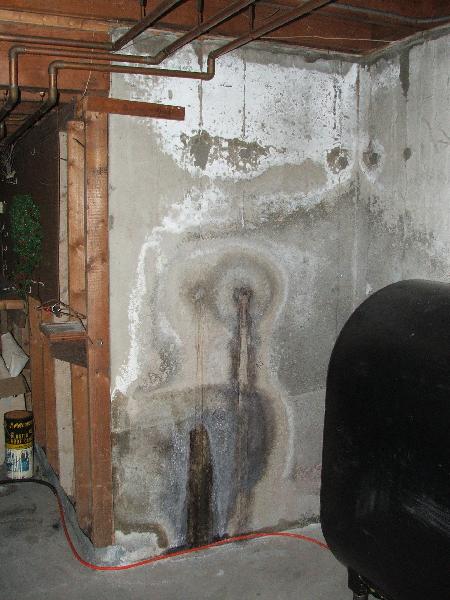
Leaky concrete basement wall
Sites for Leaking Basements - CLICK HERE .
keywords= internal concrete sealer densifier New Generation Sealer for Concrete,Limestone, Stucco, Gunite Internal Sealing(i.e. concrete sealing - internal concrete sealer)by Paul OmanIntroduction to internal concrete sealers and densifiers:
How An Internal Concrete Sealer and Densifier Works:
Applications for Internal Sealers:
Hi Paul and friends, You helped us in 2012 (SW Florida) with a very damp, smelly, no-vapor barrier, old concrete garage floor, wicking moisture from below and growing thick mold on the bottom wood shelves of garage cabinets. We used the Bio-V Seal, then after a month of no moisture evidence applied the Low-V, and it's been just like magic, so clean, no smell these 4 years since. We've made our garage into a beautiful Florida room and use it also as a guest room. Thank you so much! BOB - 5/16
Bio Vee Seal concrete sealer and densifiermolecular technology at work for youA proprietary catalyzed Potassium formulation (not a silane or siloxane)What Bio Vee Will Do For Your Concrete Surface
In short, it reacts with the natural lime in concrete to form a modified potassium hybrid in the concrete voids thus increasing surface density and hardness, thereby reducing moisture permeability and porosity. Like Gor-Tex (tm) it allows the concrete to ‘breathe' (2% vapor transmission) while preventing the migration of larger liquid (water, gasoline, oil) particles.
BECAUSE OF THIS, BIO VEE SEAL IS ALSO A RECOMMENDED, BUT OPTIONAL, PRE-TREATMENT TO CONCRETE SURFACES THAT WILL BE COATED WITH SOME SORT OF SURFACE COATING.
Benefits of Bio Vee Seal Concrete Internal Sealer and Concrete Densifier
* Inexpensive * One coat, easy to apply, application * Penetrates - no surface layer or visible presence to interfere with future surface painting or other treatments of the concrete * Forms a chemically linked bond to the concrete subsurface that will not dissolve or wear out * Improves the durability of the concrete without affecting surface texture * Water based - contains no VOCs, easy water clean-up
|
| Order this
Product
NOW from our large Primary web store |
We really appreciate you visiting PROGRESSIVE EPOXY POLYMERS, INC. and our web site: EPOXYPRODUCTS.COM. Take advantage of the CONTACT links on this page to ask questions about our products and/or your projects. You can stay in touch with us via our NEWSLETTER (link on our contact page) which is emailed every 6-8 weeks.
|
Epoxy Only Web Google Search |
|
 |
#1) Google Everything Epoxy Searches #2) Google Marine Epoxies Searches
#3)Google
Floor Epoxy Searches |
|
View our Progressive Epoxy Products, Inc. |
This current page is all about:
Bio Vee Seal
Concrete Sealer Densifier - moisture control
Too much water in your concrete slab, basement, garage? internal concrete seal -
Issues
|
|
WOW! 35% - 40% of all daily online or telephone orders are from existing customers. That's an amazing 'REPEAT CUSTOMER" number. |
|
603 - 435 - 7199 ANYTIME 24/7 FOR HELP OR ORDERS |
|
|
|
|
Meets, exceeds, or passes the following testing:
ASTM D 2939 (resistance to water solubility)
ASTM D 466 (resistance to water flow and action)
ASTM E 96 (vapor transmission: 0.04 grains/squ ft/hr; water perm. 0.102)
ASTM C 836 (vertical surfaces)
SS-W-110 C (water repellence on masonry - 1.925% average)
ASTM C 672 (freeze thaw - 100 day cycle)
ASTM C 309 (concrete cure and seal)
Supplemental testing by a state Department of Transportation:
Passed Absorption test (not to exceed 1% after 48 hours/2% after 50 days under total immersion)
Passed Scaling Resistance (no scaling after 100 cycles)
Passed NCHRP 244 Series II and Series IV (absorbed chloride less than 25%/10% of untreated cube)
150-200 squ feet per gallon
Apply with brush, roller or sprayer
Apply to dry or damp concrete surfaces
Bio Vee is a clear, water-like fluid that contains no volatile organic compounds (0% VOC) with a pH of 11.5.
Bio-Vee is available in five gallon units and has a coverage rate of about 150-200 square feet per gallon. It can be applied like water to the surface using a brush, roller, sponge, or spray bottle. A slightly damp surface actually helps the Bio-Vee penetrate the surface, but is not a requirement (except perhaps for limestone). The material cost for a Bio-Vee treatment can be less than 25 cents per square foot, making it one of the least expensive sealer and protective barrier products on the market.
Bio Vee Seal (tm) Internal Concrete Sealer and
Concrete Densifier Product Notes:
NON-HAZMAT - AVAILABLE FOR WORLDWIDE SHIPPING!
Our most common user is some sealing the concrete of a newly constructed home. The Bio Vee Seal is relatively inexpensive
and does not change or alter the appearance or future plans for the concrete basement, etc. Usually these people
purchase 5-10 gallons.
The moisture or dampness you see may not be from moisture moving up through the concrete slab. It could be condensation for damp moist air in contact with the cooler concrete slab. Obviously, the Bio Vee Seal will not reduce the moisture issue in this situation. Note also that a coat of epoxy on the concrete will SLIGHTLY (ONLY SLIGHTLY) thermally insulate the floor and reduce the condensation forming on the floor.
Apply to a test patch on your sidewalk or patio and then wait for a rainy day. You'll see the Bio Vee difference as the surrounding concrete turns dark with water saturation!
WILL SEAL UNCOATED/UNPAINTED STUCCO!
User Feedback - Internal Concrete Sealer Customer Reviews:
Hi Paul,
I purchased your Bio Vee Sealer for my concrete garage and I must say the stuff works great. It's very obvious
that water does not "seep" into the concrete now when the floor gets wet. Hopefully this will prevent
oil stains and such later on.
Nelson
9@bellsouth.net wrote:
I ordered the Bio Vee Seal and we put it down about 3 months ago in our new home's walkout basement. The damp (not
musty or mildewy), just 'wet cement and wallboard' smell disappeared within a few days. That unpleasant smell had
been seeping up and filling the main floor. I am thrilled with that result! and have the added peace of mind of
knowing that when I'm ready to lay carpet, I won't have to worry about moisture trapped underneath.
Thanks,
M
Hi Paul,
I purchased your Bio Vee Sealer for my concrete garage and I must say the stuff works great. It's very obvious
that water does not "seep" into the concrete now when the floor gets wet. Hopefully this will prevent
oil stains and such later on.
Nelson
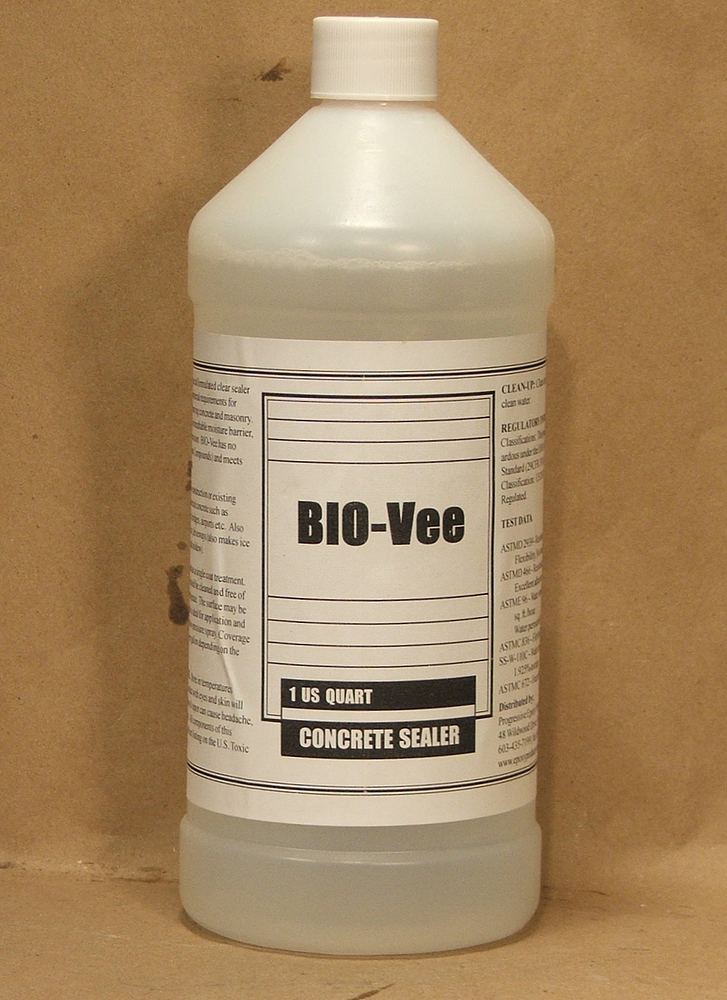 |
Bio Vee Seal internal concrete sealer Sampler Kit Bio Vee Seal helps control moisture issues in concrete (moisture migrating up or spills migrating down). It is an internal sealer, forming crystals in the surface void spaces of the concrete. it is not a surface paint like sealer. The 1 quart test unit will cover about 50 sq feet. If you like it, you can then order gallon or 5 gallon units. This product is featured on the GreatThings4u.com website. CLICK HERE to see these products in our online catalog (special purpose epoxies section). |
|
Links to Lots of MUST READ Information Articles About the Best Epoxy Floor Paints, Including Preparation, Alternatives, What Can Go Wrong, etc.
|
|
Bio Vee Seal - INTERNAL CONCRETE SEALER |
SOME OF THE SITES THE ABOVE LINK WILL DIRECT YOU TO |
|
Clear Top Coats - FLOOR CLEAR TOP |
Best Floor Epoxy - CLICK HERE |
|
Epoxy Quartz Floor - BROADCAST FLOOR |
Acid Etching - ACID |
|
Epoxy Paint Chip Floor - CHIPS |
Epoxy Paint vs. Floor Epoxy Paint - EPOXY PAINTS |
|
Epoxy Paint - SURFACE PREP |
Floor Basics/Options - START HERE |
|
Floor Epoxy - CATALOG PAGE |
Questions: ASK PROFESSOR E. POXY |
ON-LINE CATALOG HOMEPAGE.
Inside Our non-marine, commercial, DIY Catalog:
corro coat FC 2100; water gard 300; CM 15; crack coat™; liqua tile 1172 potable water; water prime
Find Corro Coat FC 2100 and Water Gard 300 epoxy in our Best Selling - fix anything Catalog
water bond (water based); industrial floor epoxy; bio vee seal; walnut shell; rough coat grit filled epoxy floor paint; epoxy clear top resi
wet/dry 700; splash zone A-788, epoxy cream; splash zone a-788
Find Wet Dry 700 epoxy in our Best Selling - fix anything Catalog
low V epoxy; basic no blush; ESP 155; Bio-Clear 810; epoxy clear top resin
Find Low V, Basic No Blush, and ES 155 epoxy in our Best Selling - fix anything Catalog
Aluthane moisture cured urethane; Acrylic Poly UV Plus and other 2 part polys ; Capt. Tolley's creeping crack sealer; india spar varnish;
Find Aluthane in our Best Selling - fix anything Catalog
fumed silica; fiber fill; micro balloons/micro-spheres; graphite; wood flour; EZ thick, rock flour;
water activated pipe wrap; TA 661 solvent-free epoxy brush cleaner; fiberglass tape/cloth
short nap epoxy rollers; epoxy/stone deck resurfacing roller; 1 inch foam brushes; 2 inch bristle brushes; tongue depressors
Questions? / Phone order? / EMAIL / CALL 603-435-7199 EST / BUY ONLINE
GOOGLE SITE SEARCH - Click here Epoxy specific site search
Click here - YouTube video. Learn about Progressive Epoxy Polymers Inc.
EVAL4U - how to evaluate your epoxy vendor - CLICK HERE -
|
Epoxy Only Web Google Search |
|
|
|
#1) Google Everything Epoxy Searches #2) Google Marine Epoxies Searches
#3)Google
Floor Epoxy Searches |
|
View our Progressive Epoxy Products, Inc. |
|
PRODUCT SPOTLIGHT: |
|
|
Wet Dry 700 Epoxy Ultimate Repair Epoxy Paste Above and below the Waterline Like Nothing You Have Ever Worked With Before! Need to fix, glue, patch, fill, bond, coat or cover something underwater? Need to reinforce/wrap corroded, damaged or leaking pipes (with epoxy and fiberglass cloth)? Need to do a fiberglass cloth and epoxy repair with a non sagging epoxy paste? (even underwater?). How about sealing electrical connections in a ‘glob’ of waterproof epoxy? Patching some wood rot? One of our customers repaired serious rot in an 100 year old marine railway submerged under 12 feet of water. Wet Dry 700 has saved sinking boats (and sunk boats - read Escape From Hermit Island available at Amazon.com. The authors recommend you don’t leave your dock without this epoxy - see epoxyproducts.com/cs_boat.html). It is also used on leaking pools and corroding barge mounted floating homes. Welcome to the world of Wet Dry 700 (tm) Epoxy Wet Dry 700 (tm) epoxy paste is a leading example of consumer driven epoxy technology, resulting in a versatile, field friendly repair product for difficult environments. Wet Dry is a solvent free, high performance epoxy reinforced with kevlar (tm) pulp and feldspar/ceramic. It can be applied to wet, damp, or dry surfaces. Wet Dry 700 looks a bit like joint compound (dry wall mud), or cake icing with a simple 1 to 1 mix ratio that you can ‘eyeball’. A scoop of Part A and an equal scoop of Part B and you are ready to go. This is one of our top selling epoxies. People first buy it for a specific project and then generally buy more just to have on hand. |
|
|
"I cannot believe how incredible this Wet Dry 700 is. It's revolutionary. The original repair to my storm shelter would have lasted years if the shelter would just shifting around in the ground. DON'T STOP SELLING THIS STUFF!" Jeff 1/2013
( 10/2013) Comments: Returning - Underwater repair |
|
|
Another Amazing Product - ALUTHANE aluminum Moisture Cured Urethane Coating - corrosion fighting, heat reflecting, temperature resistant sealer, primer, top coat. Use on wood, metal, fiberglass, cement. READ MORE |
|
|
PROGRESSIVE EPOXY POLYMERS, INC - 603 - 435 - 7199 Amazing Products - Amazing Support |
|
|
data sheets and msds and SDS sheets at epoxyproducts.com/datamsds.html |
|
ONLINE PRODUCT CATALOGS PROGRESSIVE EPOXY POLYMERS, Inc |
|
|
ONLINE STORE Purchase Here ------ or CALL 603 435 7199 ------ HOME PAGE |
|
|
Marine Catalog |
|
* home
page of marine catalog section (blue background)
|
|
| Section One MARINE - CLEAR EPOXIES Section Two FILLERS THICKENERS ADDITIVES Section Three THICKENED EPOXIES - EPOXY PUTTIES, ETC. Section Four EPOXY PAINTS (barrier coats) Section Five URETHANES AND NON-EPOXY COATINGS Section Six NON-SKID DECK COATINGS Section Seven MARINE REPAIR PRODUCTS Section Eight MISC. MARINE PRODUCTS |
|
|
MASSIVE BOAT HOW TO - ISSUES - HELP WEB LINK SITE |
|
|
Residential / Commercial / DIY Catalog |
|
* home
page of residential/commercial catalog section (brown background)
|
|
|
Section A EPOXY PAINTS Section B FLOOR EPOXIES (regular and non-skid products), SEALERS, ACCESSORIES Section C THICKENED EPOXIES - EPOXY PUTTIES, ETC. Section D CLEAR EPOXIES Section E NON-EPOXY PAINTS COATINGS SEALERS Section F MIX-IN ADDITIVES Section G OTHER PRODUCTS Section H SURFACE PREPARATION PRODUCTS Section I MISC. ACCESSORIES |
|
|
WEB EPOXY FLOOR ISSUES LINKS SITE --- WEB EPOXY REPAIR LINKS SITE |
|
|
top selling favorite products for your every need Buy Talk Chat Support EMAIL or 603 435 7199 American manufactured, distributed, and sold epoxies and coatings. Your business helps small American Family Businesses - Thank You! |

 |
 |
 |
||
|
site master |
protagonist |
ground zero |
|
|
Most Popular & Visited pages at: Epoxyproducts.com (see below) Check Us Out! |
storefronts, phone, text, email links |
|
Also check out these pages ==> |
help and info |
trusted epoxy sites |