PROGRESSIVE EPOXY
POLYMERS, INC.
Pittsfield NH 03263

LPU 2 PART POLYURETHANE COATINGS
(LPU = linear polyurethane)
We sell a 2 part white and a
2 part clear gloss with massive amounts of UV blockers
(For
use on boat hulls, cars, planes. Not for sale in Southern California.)
**
Quick
EMAIL / ph 603.435.7199 EST / Google
SITE SEARCH
/ Buy On-line
TWO
STORES / Goto Contact
PAGE / Web Product
CATALOG /
Progressive Epoxy
HOMEPAGE / View
our VIDEO / Navigation Bar
REPLACEMENT / Data
and MSDS
PRODUCT INFO
/ Epoxy Guru
HELP SITE / Top Selling
Products -
FAVORITES
* *
Your Host and
Tour Guide:
Paul Oman, MS,
MBA -
Progressive
Epoxy Polymers, Inc.
(floor epoxies, marine epoxies,
underwater epoxies, repair epoxies)
Member: NACE
(National Assoc. of Corrosion Engineers), SSPC (Soc. of Protective Coatings)
Board member:
Friends of the Suncook River
- 501(c)(3) non profit ----- Founder:
Friday
Night Paddlers .
We are the only technology based coating/epoxy/resin
company that actively encourages your business hour phone calls (East Coast), We
answer emails 24/7/365. We form a
personal relationship with our customers and freely
share technical information, how to-advice, product
information and tips-and-tricks. Speak with a
non-salesman technical professional with over 25
years of experience in the resin/coating industry.
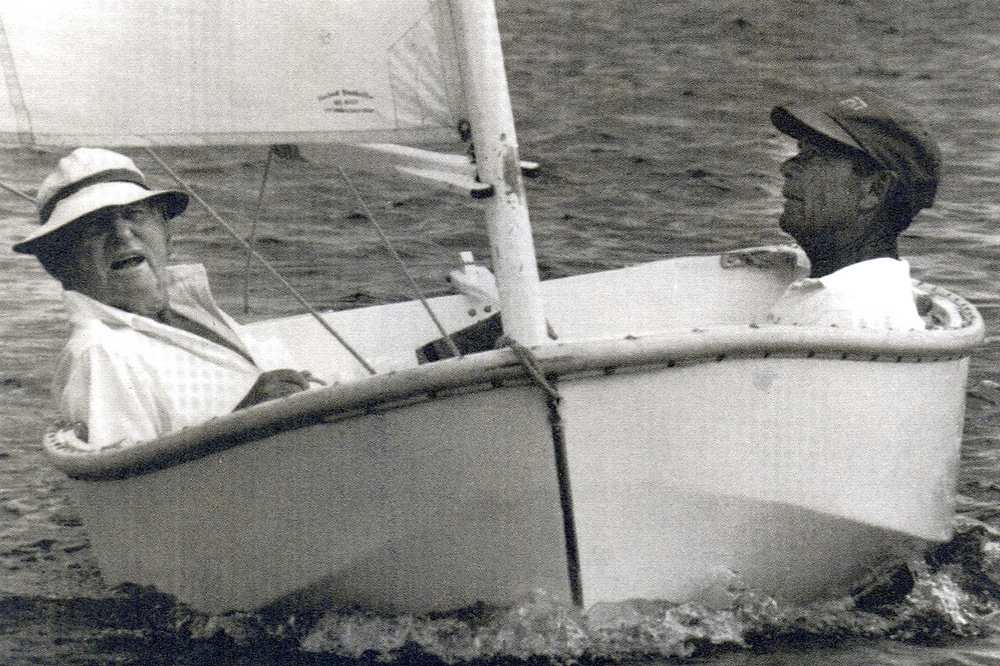
Joseph E. Jessop (age 92) and Jack Sutphen (1990's/80's?)
photo by Bob Couarnubias
Two-Part
LPU Urethane Paints (polyurethane)
& Clear-Coats
The following is an introduction into 2-part urethanes and 2 part urethane clear-coats. These two-part LPU paints
are perhaps the best performing coatings (low yellowing, high gloss, durable and tough physically and chemically)
available for brush, roller or conventional spray application.
Most, if not all, 2-part urethane paints are either acrylic polyurethane paints or polyester polyurethanes paints.
Sometimes the prefix “poly” is left off. These are also called linear (or aliphatic) urethanes, or LPUs (linear
poly-urethanes). In any case, lots of ‘keywords’ for generally two kinds of 2-part
polyurethanes.
Polyester (poly) urethanes are considered the ‘best’. Compared to acrylic (poly) urethanes the polyesters are more
abrasion resistant, stain resistant, and more chemical resistant. You’ll find polyester urethanes on jet airplanes,
and on the floors of the hangers these airplanes live in. Boat owners should
note that operating a boat in water, especially seawater, is very much a chemical environment. Two very well known
2-part marine paints, (we will not say their names) are polyester urethanes.or acrylic/polyester urethane blends.
Acrylic urethane coatings are a bit cheaper and generally one notch down from the polyester urethane paints in
terms of toughness and chemical resistance, but still above ‘regular’ paints. Acrylic urethanes are found in clear-coats
used in the automobile industry and ‘city water towers’ that grace many
small towns in America. Boat owners should note that Awlcraft 2000 (tm) is an acrylic urethane, as probably are
most of the 2 part urethanes sold in marine catalogs that don’t specify if they are polyester urethanes or acrylic
urethanes.
APPLICATION PROPERTIES: Both kinds of urethanes contain large amounts of solvents and thus have a strong solvent
smell. That said, additional solvents are often added during application. In the urethane world solvents are called
reducers. There are ‘fast reducers’ for spray application. These speed up the time it takes for the urethane to
‘gel’ on the surface. “Slow reducers” slow down the gel time for more working time when applying by brush.
Brushing on a two-part urethane is not like brushing on a varnish or oil based enamel. The thin, almost watery
urethane (you’ll probably need two coats or more to cover) starts to ‘gel’ on the surface quickly. Unlike varnish,
you’ll get 2 or 3 brush strokes and then, like it or not, it’s time to move on. An application method called ‘tip
and roll’ gets almost sprayer like results by applying the urethane with a roller and then gently removing the
roller marks with the tip of a brush. If is likely you will not be happy with the results of a brushed on application
on such things as boat hulls, epoxy table tops, etc...
In my experience, both the acrylic and polyester urethane coatings go on about the same, but the general view is
that the acrylics are slightly easier and friendlier to apply and, perhaps, repair.
Urethane’s weakest link is their adhesion. Because of that they are often applied over an epoxy primer. Besides
priming the surface the epoxies tend to ‘level the surface’ too, important because the high gloss urethanes will
show every flaw in the subsurface.
Recoat window for two-part urethanes is about 6 to 16 hours. Beyond that, sand lightly. Apply only in good, dry
weather, as urethanes are moisture sensitive during application and curing. The coating will become dry overnight,
hard in about 3 days, with maximum hardness in 7-10 days.
EVALUATING YOUR TWO-PART URETHANE: Obviously, the first question is, is it an unmodified polyester polyurethane
or an acrylic urethane? Next, what is the price (two part urethanes sold in marine catalogs are priced sinfully
high)? Finally, look at percent solids.
Percent Solids: these coats, like most other coatings, consist of some amount of solvents which evaporate away
(called VOCs - volatile organic compounds) and what is left behind is the ‘solids’ of the coating. A coating with
40% VOC has 60% solids. Apply a 10 mil (1/1000 times 10 in inch units) coating of this product and when dry you
will have 6 mils on the surface. Some manufacturers describe it in terms of coverage for 1 dry mil of their product.
A coating with 0% VOC (most epoxies) will have a dry 1 mil coverage amount of 1604 square feet. A coating with
50% VOC will have a 1 mil dry thickness coverage rate of 802 square feet ( you applied 2 mils over the 800 square
feet and 50% of it evaporated
away).
The higher the solids (the lower the VOC) the more paint you are actually getting on your surface. One of the leading
vendors of ‘boat hull’ 2-part urethanes does a wonderful job of providing their technical product information on
their web site. Their web site reports 1 mil dry film thickness of 570 square feet for their original polyester
urethane and 846 square feet for their version 2 polyester polyurethane. Their acrylic urethane product (introduced
around 2000) reports 512 square feet at 1 mil dry coverage.
NOTE OUR 2 PART POLYS CANNOT BE SOLD IN CALIFORNIA
AND ARE ONLY APPROVED FOR APPLICATION ON MOBILE EQUIPMENT SUCH AS CARS, BOATS AND PLANES. SEE OUR
VOC PAGE FOR DETAILS.
URETHANE CLEAR-COATS:
Urethane Clear-coats are almost a different topic from pigmented urethanes and much of that is due to UV blocking.
UV rays damage and fade coatings. It yellows and damages epoxies. One of the best blockers of UV rays is pigmented
paint. The pigments block the UV, limiting their affect to the very surface only. Clear coatings, of course, have
no pigments to block UV, hence, while they add additional gloss and ‘depth’ to a fine paint job, they are generally
considered to be performance inferior to the pigment coatings they commonly go over.
There are UV blockers that can be added to clear 2-part urethanes, but surprisingly a very minimal ‘UV Package”
is generally added to these clear urethanes (automobile Clear-coats are an exception). The additives
are expensive (about $8 per gallon) and since most clear urethanes are applied over pigmented urethanes the manufacturers
tend to let the pigments in the bottom coating perform the UV blocking.
The Acrylic Poly UV Plus™ offered by Progressive Epoxy Polymers (mentioned above) is also an exception. This clear-coat
acrylic polyurethane has the maximum amount of UV blockers that can be added. Progressive Epoxy also sells both
‘fast’ and ‘slow’ urethane reducers, as well as moisture cured urethanes and, of course, all kinds of epoxies!
SEE LINKS BELOW.
| Stopping UV
damage and UV yellowing
---------------- Josie Lewis (6/2010) wrote:
Hi Paul: I recently
purchased some clear epoxy and Acrylic Poly UV Plus from your
company. I have access to a UV chamber which simulates high altitude
direct UV exposure. I thought you might be interested in my
findings. I used a Masonite panel painted white and then coated with
the epoxy. On half of the epoxy coated panel, I brushed on one coat
of UV Poly and put it in the chamber for 644 hours at 50 C (the heat
accelerates the exposure). Attached is a picture of the results. The
masonite cracked a bit and separated due to a bit of wetness in the
wood (unrelated to the resin). The epoxy ambered dramatically
within about 50 hours. After 644 hours, the UV Poly showed a slight
bit of ambering from the original control but it is marginal at
worst. The technician who ran the test said if it isn't yellow at
644 hours it is basically indestructible. I also tested several
other 2-part resin products with the UV Poly and had the same
result. You have a great product. I now feel secure knowing that my
resin art, protected with the Poly UV Plus, will be archival and
protected for long years. I will be ordering more soon!
Best, Josie (6/2010)
Order Acrylic Poly UV plus - cannot be
sold in Calif. - and all our other products at our
King
Cart Storefront. Acrylic poly UV Plus
is in the non-epoxy section.
Two Part Poly info/web site -----
UV issues -----
Epoxy/Poly Only Google Search -----
Visit the Epoxy Guru
|
LPU paints offered by
Progressive Epoxy
(cannot be sold in California):
Acrylic Poly UV Plus - GLOSS with UV
blockers and absorbers)
LPU marine - white polyester
poly
Find the Polyester or Acrylic Polyurethane
UV in our Marine Catalog -
click here -- LPU paints
Find the Polyester or Acrylic Polyurethane in
UV our Industrial Catalog
- click here -- LPU poly paints
| Order this two
part
Product
NOW
from our large Primary web store
|
|
Save over 50% (hundreds of dollars!)
On 2-Part Marine Topsides Paint
Two part polyurethane paints are the
best of user applied coatings.
Automobiles and fine yachts use them
We offer two outstanding products.
One is a snowy white yacht coating (LPU
Marine) and the other is a Clear
with massive UV protection
(something not often found in even
the most expensive two-part polys -
auto clear coat being the
exception).
We checked the prices for similar
Awgrip brand polys at discount
marine supply store WEST MARINE (Feb
2019). Their polyester polyurethane
white sells for $280 per gallon.
(that’s $420 for 1.5 gallons - vs.
$199 for our 1.5 gal package). Use
our LPU Marine polyester poly and
save 53%.
Our clear acrylic poly (Acrylic Poly
UV Plus) vs. their clear Awlcraft
2000 clear acrylic poly (which
doesn’t have the UV blockers and
absorbers that our product does - a
really valuable addition) - sells
for $149 per gallon vs. their price
of $270 per gallon.
|
WHY ALMOST NO UV PROTECTING
CLEAR COAT PRODUCTS:
Two reasons why there are few clear coat
products available with UV blockers. One is cost. These additives for clear
coats are expensive. Second, most clear coat products go over pigments coatings
that are not epoxy and do not yellow (but might still fade a little bit). Simply
the top coating of epoxies with a clear coat is a small market, that few address
(except for our Acyrlic Poly UV plus mentioned above.). So, if some vendor tells
you they have an special clear top coat for epoxy surfaces and it doesn't really
mention special additional uv blockers etc. added to it (don't think there are
any), they you already know they are stretching the truth because the product
wasn't designed with epoxies in mind. Some vendors just 'forget' to mention
epoxy yellowing entirely. LET THE BUYER BEWARE.
Fisheyes -
surface contamination
NOTES: 2 part poly paints are really sensitive to surface contamination
problems etc. Guys that paint cars use 2 part poly paints. They use a product made by Du Pont and sold at auto
part stores called 259S Paint Additive (quote: an additive for topcoats and clears to eliminate fisheyes, craters
and other surface defects). I paid $22 for a pint of it in 2003.
Reasons for coating failures
Preparation problem 70%; application problem 12%; environment problem 6%; wrong paint selection 9%; bad
paint 1%; adding thinner 2%
"At least 70% of premature coatings failures are traced back to 'surface preparation' whether referring to
wood, concrete, or metal. In a commercial recoating project, the costs (and profit) associated with surface preparation
are about 70% of the job. How extensive the surface preparation is will depend on the performance expectation of
the owner... Know the A, B, C's of surface preparation - visible contaminants, invisible contaminants, and profile."
Dr. Lydia Frenzel, The ABCs of Surface Preparation, Cleaner Times, April 2001, pg. 42-44.
We've found that most problems are the result of recoating too soon. Recoat epoxies
after 24 hours, for putting different kinds of coatings over each other, wait at least 48 hours. Our aluminum filled,
moisture cured urethane is an exception. Topcoat within 16 hours.
Progressive Epoxy
Polymers, Inc.
Located in No Sales Tax - New Hampshire (homepage)
EPOXY PAINTS AND RESIN SYSTEMS
1 AND 2 PART URETHANES - COATING SUPPLIES
"The Right Epoxy fixes Everything!"
Visit our Subject / Catalog contents
PAGE
####