PROGRESSIVE
EPOXY POLYMERS, INC.
epoxyproducts.com
Your Host and Tour Guide:
Paul Oman, MS, MBA - Progressive Epoxy Polymers, Inc. (floor epoxies, marine epoxies, underwater epoxies, repair epoxies)
Member: NACE (National Assoc. of Corrosion Engineers), SSPC (Soc. of Protective Coatings)
Board member: Friends of the Suncook River - 501(c)(3) non profit ----- Founder: Friday Night Paddlers .
"Professionals helping Professionals since 1994"
Click here - YouTube video. Learn about Progressive Epoxy Polymers Inc.
Clear Coatings (epoxies and non epoxies
in our non-marine online catalog - CLICK HERE
GOOGLE SITE SEARCH - CLICK HERE
Clear coatings and clear epoxies - Info you need to know
1) All epoxies yellow in UV (more on UV affects on epoxy - CLICK HERE). This includes both clear epoxies and pigmented epoxies. Clear epoxies turn yellow or golden colored. Blue epoxies turn greenish when they yellow. In short, epoxies are not color stable. This has to do with the chemistry of epoxies (CLICK HERE). All epoxies will yellow, some quicker than others, but all will suffer from UV yellowing and UV breakdown and deterioration. UV blockers CANNOT be added to epoxies. Anyone that claims they have a non yellowing and/or UV resistant epoxy is either not telling you the truth or stupid when it comes to knowledge about epoxies. Do not deal with them or the companies they represent! The best fix for UV issues with epoxy is to either use them indoors or cover them with pigments top coat paints that will block the UV. UV blockers CAN be added to one or two part polyurethanes, but with a few exceptions this is not done. The UV blocking additives, which must be clear for use in clear coatings, are expensive and would generally price the product out of the marketplace. Assume that any clear coat product you purchase, even expensive ones, do NOT of significant amounts of UV protecting chemicals added to them. There are exceptions. See below.
2) UV blockers and absorbers can be added to one and two part non-epoxies, but rarely are, as mentioned above. The most obvious exception is automotive clear coat. Given the price of cars and the competition between car manufacturers, a few bucks more in the paint job is nothing. Traditional (the real stuff) marine spar varnish (like our India Spar Varnish - not for sale in California - more on varnish in general - CLICK HERE) has natural UV blockers. That said, spar varnish is not clear. It is amber in color - although when brushed on in a few thin coats, it looks pretty much clear except over white surfaces. Only sold in quarts - coverage is about 75 sf per quart.
3) Acrylic Poly UV Plus is our two part poly especially formulated for me/Progressive Epoxy Polymers, Inc with MASSIVE amounts of UV blockers and absorbers. It a LPU coating (more on LPU coatings CLICK HERE) and very similar to auto clear coat, but cheaper. Two part LPU coatings have high solvent levels (very stinky) and NOT user friendly to apply. You just don't brush or roll it one (except on an epoxy floor) and get a perfect, invisible, flawless finish. It is usually sprayed on or applied manually via a method called "roll and tip." As you might expect, Acrylic Poly UV Plus is not for sale in California. We carry this product mostly to keep epoxy floors from yellowing and into which the colored chips in epoxy / colored chip floors are applied (except for very low end applications where the chips are sprinkled directly upon the pigmented epoxy paint). See link on epoxy chip floors - CLICK HERE.
4) Our clear epoxies are generally use for: boat building and repair (Basic No Blush more on No Blush - CLICK HERE), table tops, bar tops, penny floors, "metallic epoxy floors, and sealing shipping container floors (Bio Clear 810, Basic No Blush, ESP 155 epoxies are the bar top epoxies). ESP 155 is an epoxy sealer and primer - (CLICK HERE for more about ESP 155). Visit our site on Bar Tops - CLICK HERE. We also have a site for Penny Floors - CLICK HERE). Our Low V clear epoxy is often used for rot repair (CLICK HERE) and for sealing the floors of shipping containers (CLICK HERE for more on shipping container floors). Also for boat blister repair (CLICK HERE).
5) Our clear non-epoxies are the LPU coating, Acrylic Poly UV plus, mentioned above, and the semi clear India Spar Varnish.
6) Only the Bio Clear 810 epoxy, Basic No Blush epoxy, Low V epoxy can be sold and shipped to California. None of the products are shipped outside of the Lower 48 states.
7) You can purchase any of these products, and/or get support / advise / help over the telephone by calling our east coast office at 603 435 7199. Order online 24/7 from our two online stores (the solvent based, non California products are only listed in our PRIMARY online store).
8) We like well informed customers. Hopefully you appreciate the information we have shared and will make your purchases from our company, Progressive Epoxy Polymers, Inc. (HOMEPAGE - links to our online marine and non marine product catalogs), located in no-sales-tax New Hamsphire.

Getting the ultimate - longest lasting clear finish for your boat or furniture - results of a 1.5 year test
best option for outdoors
Minwax (tm) oil stain - left to dry for 2 weeks - 2 coats ESP 155 epoxy sealer and primer - 4 coats of India Spar Varnish (note ESP 155 and Varnish not for sale in California)
For about a year and a half I've been testing
various urethanes, varnishes etc. to discover which will work best at sealing
and maintaining its shine outside. My test platform was a wood slotted park
bench I owned. My test zones where the right and left halves of the seat slots
and the left and right half of the backrest - about 12 different ‘zones'. The
bench was coated and left outside in New Hampshire for 2 summers and 1 winter
(buried under the snow). The coatings consisted of our traditional spar varnish
(we sell it as India Spar Varnish) , a clear polyurethane from Home Depot, our
clear, solvent free, thin, Low V epoxy, our 2 part (LPU) clear polyurethane
with UV blockers and absorbers. Multiple coats of each were used and multiple products on each slot (except on
the backrest where varnish was used on one side and poly on the other).
The absolute worst product was the Home Depot one part polyurethane. It failed and peeled miserably.
The best product mix were the epoxy and the varnish and the 2 part clear polyurethane (our Acrylic Poly UV Plus).
For years we have been telling folks that vanish over clear epoxy was a winning combination. I learned that from
maintaining the bright-work on a sailboat located on Galveston Bay for 10 years.
Seal the wood with the epoxy and then protect the epoxy with varnish. This test
proved how good that system works. The half slot still looked bright, shiny and
new. The slot with the epoxy, varnish and the 2 part clear poly looked just as
good. The other combination of coatings all fell someplace in-between. All products really
like having an epoxy base. The water- based product lost its shine and just didn't hold up as well as the other
products (which matches my experiences with most other water based coatings).
So if I were going to clear coat a big wooden sailboat mast (or outdoor
tables, front doors, etc) that wasn't going to get any additional TLC for a few
years, how would I coat it?
1) one or more coats of our solvent thinned clear epoxy primer (ESP 155). The solvents help seal the wood and penetrate
below the surface. This is important as I have found the coatings (even epoxies) begin to fail on edges and corners
where air and moisture can get under the coatings. Anyway, begin by sealing with a solvent thinned epoxy primer.
2) I would then add 2 or 3 coats of our watery, clear, solvent free epoxy called Low V. This product could be solvent
thinned too and used in place of the solvent based epoxy primer (ESP 155) mentioned above, but I would personally
rather use the ESP 155 as I suspect it would penetrate better. The Low V epoxy in this step provides a serious
barrier coat to the wood and adds film thickness. Film thickness is a good thing, it keeps scratches and nicks
away from the wood.
NUTSHELL - AN EPOXY BASE WHICH STABILIZES THE WOOD AND PROVIDES AN EXCELLENT BONDING SURFACE FOR THE VARNISH. THE ESP 155 IS A SOLVENT THINNED, WATERY EPOXY WITH LITTLE FILM BUILDUP. THE LOW V EPOXY IS A THICKER EPOXY WITHOUT SOLVENTS THAT ROLLS ON EASILY (OFTEN USED TO SEAL SHIPPING CONTAINER FLOORS). BASIC NO BLUSH EPOXY IS A STILL THICKER, SOLVENT FREE EPOXY USED FOR BOATBUILDING AND RESEALING PEBBLE STONE DECKS.
3) Next would be 3 or 4 coats of
varnish. I have never noticed a difference between marine varnish, spar varnish,
or ‘varnish' from the hardware store (albeit I haven't done any tests). The varnish protects the epoxy and gives
the surface a ‘warm' look and feel. It also adds more film thickness.
Protecting clear epoxies with marine spar varnish Those show-piece wood strip canoes and kayaks, and sometimes the varnished bright work wood trim on yachts are sealed or built with any of the clear epoxies mentioned above. A few coats of varnish (pretty much any kind of varnish works) over the epoxy will protect the epoxy from UV damage. The epoxy seals the wood better and longer than the varnish, while the varnish protects the wood and bonds long term better to the hard epoxy than it does to the porous wood - a great win-win combination. I've tried all the other UV protecting topcoats over clear epoxy and for that mirror yacht gloss nothing works as well as varnish. Unfortunately, traditional varnish is being phased out. Find out why - Click Here.
Remember, varnish over epoxy. Always. Our two part clear poly is unique because of its UV blockers and absorbers and not available any place else. It should serve as a good, long lasting protective coating for the varnish.
|
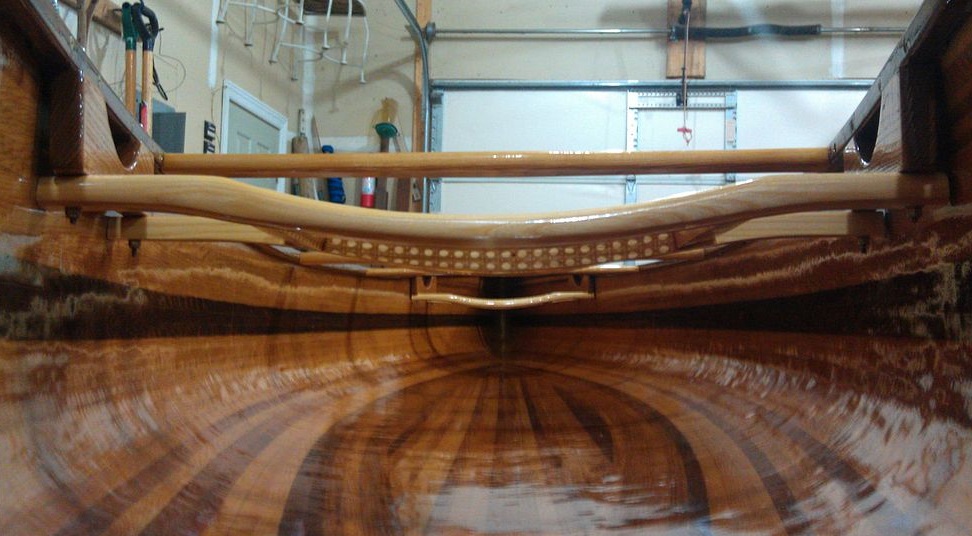
Doug: " I have your India Spar Varnish on my cedar strip canoe and it looks great! Inside photo of the canoe attached." |
4) You could stop here and be very happy with the results for perhaps several years. However, I would suggest 2
or 3 coats of our 2 part clear poly on top of the varnish. The UV blockers and absorbers will protect all the coatings
below it. The toughness of the poly should also protect the softer varnish under it. My tests show good bonding
with the varnish (probably because of the large amounts of strong solvents in the 2 part polys, they chemically
etch into the varnish, offering both a mechanical and chemical bond). When applied just over the epoxy, there was
a bit of whiteness present, not the case when applied over the varnish (probably more ‘fusing' between the softer
varnish and the 2 part poly that provided a better "air/moisture" seal. Note that the 2 part poly layers
are very thin, not much protective additional film thickness. Note that 2
part polys are $$$, so folks often stop with the varnish over an epoxy base.
ESP 155 epoxy, India spar varnish, and 2 part Acrylic Poly UV plus - cannot be sold in California
EMAIL (FEB 06): Hello:
I just bought some of your Low V epoxy and it is superior in every way to the system 3 products I (formerly) used,
their clear coat and mirror coat.
Less money, better adhesion, better flow, better release of trapped gas, clarity, speed of cure, and machineability.
It's like night and day, and their product is nothing to laugh at!
Great Product, I will buy *whatever* I need from you in the future.....
GREG
CLICK HERE TO GOTO OUR USER NOTES SECTION: FEEDBACK FROM FOLKS WHO HAVE USED THIS AND
OUR OTHER PRODUCTS.
Hi Paul: I recently
purchased some clear epoxy and Acrylic Poly UV Plus from your
company. I have access to a UV chamber which simulates high altitude
direct UV exposure. I thought you might be interested in my
findings. I used a Masonite panel painted white and then coated with
the epoxy. On half of the epoxy coated panel, I brushed on one coat
of UV Poly and put it in the chamber for 644 hours at 50 C (the heat
accelerates the exposure). Attached is a picture of the results. The
masonite cracked a bit and separated due to a bit of wetness in the
wood (unrelated to the resin). The epoxy ambered dramatically
within about 50 hours. After 644 hours, the UV Poly showed a slight
bit of ambering from the original control but it is marginal at
worst. The technician who ran the test said if it isn't yellow at
644 hours it is basically indestructible. I also tested several
other 2-part resin products with the UV Poly and had the same
result. You have a great product. I now feel secure knowing that my
resin art, protected with the Poly UV Plus, will be archival and
protected for long years. I will be ordering more soon! Best, Josie (6/2010)
Order Acrylic Poly UV plus - cannot be
sold in Calif. - and all our other products at our
King
Cart Storefront. Acrylic poly UV Plus
is in the non-epoxy section.
Stopping UV
damage and UV yellowing
----------------
Josie Lewis (6/2010) wrote:
|
Different Clear Epoxies -- Comparisons
(As a professional coatings company we offer a range of clear epoxies with unique properties and applications. This is a very different approach than marketing companies that only offer one product with one application per web site and are far removed from the manufacture and testing of their resold resin)
ESP 155 - solvent based, thin, sealing epoxy often used on wood, concrete and fiberglass. The Part B ranges from clear to dark red. Not for sale in California. Yellows quickly. Commonly used as a sealer and primer under marine spar varnished (i.e. India Spar Varnish - not for sale in California) surfaces, such as bar tops, outdoor furniture and bright-work on boats/yachts. Epoxy and Spar Varnish is a win-win combination. The varnish provides UV protection and a high gloss easily maintained surface and the epoxy provides a stable base for the varnish. For a thicker epoxy base, use Low V epoxy or Basic No Blush epoxy (listed below) under the varnish. Packaged in 2 quart kits (1 to1 mix ratio). LOW V - A solvent free, low viscosity epoxy often used as sealer or a easily rollable/brushable base on wood bars, cement floors etc. Also used to 're-bond' delaminated damp boat decks with their fiberglass 'skin'. Popular for wood rot repair too as it is thin (to soak in) odorless, and will bond to wet or damp surfaces. It is slightly amber and will yellow quicker than most epoxies. It was originally designed for concrete crack injection. Can be used under a varnish topcoat, giving a thicker epoxy base than the solvent based ESP 155. Can be allowed to flow over the edges on table and bar tops (but it is thin). Comes in 48 oz and 1.5 gal units. (2 to 1 mix ratio).
BIO CLEAR 810 - A solvent free clear epoxy, non brittle epoxy used exclusively for poured on table and bar tops. Very low levels of epoxy yellowing and contains bubble breakers. It requires being poured on at 1/4 inch layers which requires a edge or dam all the way around the surface to prevent it from simply draining onto the floor. If applied too thin it will fisheye due to the surface tension reducing bubble breaker additives. It is a favorite of professional poured on epoxy experts. It has a very slight amber tint. Comes in 48 oz 1.5 gallon and 3 gallon kits (2 to 1 mix ratio). THIS IS THE ONLY TABLE TOP EPOXY THAT USES A CYCLO-ALIPHATIC FORMULATION AND CONTAINS NO NONYL PHENOL (THAT IS WHY IT IS THE BEST AND THE FAVORITES FOR PROFESSIONALS_ BASIC NO BLUSH - one of our most popular epoxies and one of the most clear epoxies available. It has normal or slightly slow epoxy yellowing. It is commonly used for boat building or boat repair as well as resealing or creating pebble deck surfaces (common around pools and patios in Florida and other warm states. Also used to fill knot holes and cracks in wooden slabs used for bars and tables (sometimes tinted black when filling cracks and knot holes). Forms a hard, fairly brittle surface that handles outdoor weather very well (excluding normal UV yellowing and UV breakdown). Also used on bar and table top surfaces under varnish. Being semi thick it will not lay completely level in temperatures under about 75 degrees. It does contain bubble breakers (which is why the Part A appears slightly cloudy in its container. For table and bar tops use the standard temperature curing agent. For other applications use the low temperature (down to about freezing) winter curing agent. For hot weather (upper 80s and 90s) use the slower summer curing agent. The special summer and winter curing agents are only available for this one epoxy. Comes in 3 quart and 1.5 gallon kits (2 to 1 mix ratio).
|
|
Add a warming tone to your clear epoxy, solvent based clear coat, or enhance your India Spar Varnish amber tone. Order our 4 ounce "Warm-Tone Dye Solution" additive - good for warming about a gallon of clear coat. Find it in our Marine Catalog/Section 8-Misc. --- Industrial/Home Catalog/Section I-Misc. ---- (It's in the MISC section of our 3rd party storefront when you order online). |
Legal Stuff / Returns
NOTICE: Legal notices, Terms of Service, warranty information, disclaimers, health warnings, etc. are required reading before using web site, ordering and/or using Products. Any such use and/or ordering, online or by telephone, shall constitute acceptance and knowledge of all such terms.
CLICK HERE to access these terms. Please note: Whenever you purchase from this web site, and with each new purchase, you are granting us full and complete permission to add you to our email newsletter list at our option.RETURNS: call or email for authorization to return.
Returns are subject to a 25% restock fee. Customer pays return shipping and must comply with federal DOT shipping requirement/labeling for hazmat epoxies under penalty of fines and legal action.
Navigation Bar frame replacement CLICK HERE mobile friendly key site links