GOOGLE SITE SEARCH - Click here
Your Host and Tour Guide:
Paul Oman, MS, MBA - Progressive Epoxy Polymers, Inc. (floor epoxies, marine epoxies, underwater epoxies, repair epoxies)
Member: NACE (National Assoc. of Corrosion Engineers), SSPC (Soc. of Protective Coatings)
"Professionals helping Professionals"
PROGRESSIVE EPOXY POLYMERS, INC.
|
PAGE AND SITE NAVIGATION |
|||||||||||||||||
|
Epoxy Education Links Page ====> This 'Linked To' Sub-PageandEpoxy Floor Links Page ====> This 'Linked To' Sub-Page
No Sales Tax applied. Save Money, you're shopping in Tax Free New Hampshire
MEMBER: Internet Epoxy Confederation (IEC - CLICK HERE TO VISIT) -- "Where Professionalism Still Matters"
We've been selling epoxy - marine epoxy (boat building - wood / fiberglass repair) industrial coatings - garage paint - underwater epoxies - thick putties - tabletop resins and supplies since the early 1990's |
Epoxy Floor Section in our online catalog - CLICK HERE
Causes of Pinholes/air bubbles and Blisters - Industrial concrete comes in a wide range of qualities, particularly in terms of capillary voids, intergranular spaces, and trapped air pockets. When protecting concrete with epoxy coatings, or any surface coating, pinholes/ through the coating sometimes form. They have two possible causes. First, they can be caused by air trapped below the coating in tiny surface voids. The air expands outward before the coating has cured due to solar heating. See picture below.
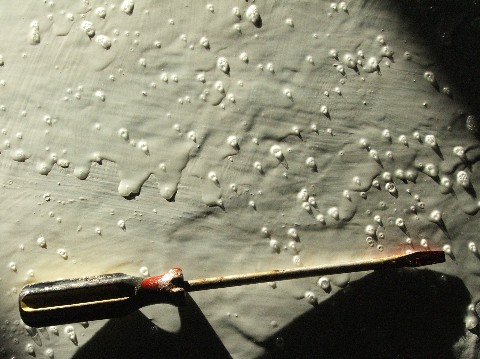
This type of pinholing/bubbles is common
on exterior surfaces coated during the cool morning hours. As the air temperature climbs during the day the concrete,
and the air filling its near-surface spaces warms. The warming air expands against the uncured fresh surface coating
producing a bubble or blister that frequently opens leaving a tiny crater and a central pinhole opening revealing
the throat of the underlying air space (i.e. outgassing).
Secondly, pinholes can form when the liquid coating forces itself into interconnected surface voids displacing
and concentrating the air into other adjoining spaces where a blister or pinhole forms. Simply put, air forced
out of some voids finds its way into adjoining spaces. Push the air out of Space A and it reappears in Space B.
The combined air from Space A and Space B, both now in Space B, push outward toward the surface, forming a blister
or pinhole.
Either way, air forced out of freshly coated concrete can ruin the integrity of the coating. The problem, of course,
is not with the coating but rather with surrounding conditions associated with temperature, expansion and capillary
action.
Bubbles/pinholes are not very common in residential
garages. There the concrete is in the shade and usually it was compacted/pressed when poured, leaving very few
air voids. Bubbles can be a big problem in: outside walkways, new barns, warehouses, workshops, hangers, etc (big
commercial projects).
Reduce or eliminate by sealing the cement first
with a thinned epoxy sealer like our ESP 155™.
Fish eyes - Pin holing should not be confused with fisheyes. Fish eying occurs due to surface
tension differences between the coating and a grease or silicon (sometimes even dust) particle. Simply put, the
coating pulls away from the contaminant, leaving a tiny crater like structure in the coating. This crater is not
connected to a subsurface air filled space. Fish eying is almost always a surface preparation problem.
We really appreciate you visiting PROGRESSIVE EPOXY POLYMERS, INC. and our web site: EPOXYPRODUCTS.COM. Take advantage of the CONTACT links on this page to ask questions about our products and/or your projects. You can stay in touch with us via our NEWSLETTER (link on our contact page) which is emailed every 6-8 weeks.
This current page is all about:
|
|
WOW! 35% - 40% of all daily online or telephone orders are from existing customers. That's an amazing 'REPEAT CUSTOMER" number. |
|
603 - 435 - 7199 ANYTIME 24/7 FOR HELP OR ORDERS |
|
|
|
|
Pinhole/bubble Solutions - Coating
applicators have several options for minimizing the formation of pinholes. Eight of them are listed below:
1) PRIMARY FIX - Only apply
coatings when surface temperatures are at or past their afternoon peak A cooling surface will actually ‘suck' coatings
into their matrix as trapped cooling air contracts. This may mean applying the epoxy at night.
However, should the temperature drop
below the dew point, some low quality epoxies will ‘blush' (create a waxy surface layer that must be washed away
prior to topcoating).
2) Additional or extra abrasive blasting of new concrete surfaces may more completely open matrix void spaces,
thus reducing the number of tiny pinhole causing ‘throats'.
3) Completely wetting down the surface with water will tend to displace air filled void spaces with water. Water
expands much less than air when warmed. This approach requires the use of water tolerant epoxies to coat the still
damp or wet concrete. Fortunately such solvent-free epoxies are becoming increasingly available and are now routinely
specified in design plans. Progressive Epoxy Polymers (www.epoxyproducts.com) offers such epoxies.
4) In addition to moisture tolerant epoxies, Progressive Epoxy Polymers also offers a product called Bio-Vee
. This non-epoxy is both
a concrete fortifier as well as a sealer. The water-like material soaks completely into the concrete reacting with
it to form tiny crystals between the concrete matrix grains. The result is a less porous, denser, concrete. Bio-Vee
helps fill the pinhole causing air filled void spaces with a solid crystalline grain.
5) If the coating is being applied by sprayer, a quick splatter coat can be applied. This quick coat covers approximately
50% of the surface with discrete paint blobs. Air displaced from surface voids by capillary action pulling the
coating into the concrete migrates into adjoining spaces. This additional air can easily be vented to the surface
over these uncoated areas. Then the final complete coating is applied there is less air to be trapped, concentrated,
and expelled.
6) The surface can be primed with a water-based epoxy primer. These new-generation of epoxies are approximately
50% water. They have a pot life of hours and a surface dry time of an hour or less. Thinning and clean-up is accomplished
with ordinary water. Such epoxies are commonly used for safety striping and as a thin epoxy primer. This technique
combines the method of wetting down the surface with water plus at least partially filling the intergranular spaces
with epoxy. When topcoating with an epoxy (or other coating) that cannot be applied to a water-wet surface, this
method has obvious advantages.
7) Apply a very low viscosity, penetrating, solvent-free (or solvent based), epoxy seal coat. This will fill the
capillaries, reinforce the surface and provide an ideal substrate for the epoxy topcoats. Any air bubbles that
form will simply pop and the thin epoxy will reseal the surface. This coat will also serve as a bond or tie coat
to the often thicker and sometimes drier (especially patching epoxies) topcoat. This is a common approach by contractors.
8) The surface can be coated with a very thick (thixotropic) coating. The thixotropic gel is strong enough to resist
the expulsion of subsurface air. Note that the air will remain trapped at the coating interface. Several of these
coatings contain Kevlar (tm) microfibers that provide exceptional surface strength and durability. These coats
are probably 30, 40 or more mils thick.
9) Apply a thin coat of your Industrial Floor epoxy, thinned with solvent (maybe 30%) as a primer coat before your
unthinned topcoat. This thin coat will fill the air voids near the surface. Any bubbles that form will not form
giant bubbles because the coating thickness is too small and any bubbles are more likely to surface, pop and reclose.
Disclaimer: the above
are suggestions and hints only. Pinholes, air bubbles and blisters are a surface preparation and/or application
issue and are the responsibility of the purchaser - end user and the the epoxy vendor.

 |
 |
 |
||
|
site master |
protagonist |
ground zero |