PROGRESSIVE EPOXY POLYMERS, INC.
Pittsfield NH 03263
Quick EMAIL / ph 603.435.7199 EST / Google SITE SEARCH / Buy On-line TWO STORES / Web Product CATALOGS

** Quick EMAIL / ph 603.435.7199 EST / Google SITE SEARCH / Buy On-line TWO STORES / Goto Contact PAGE / Web Product CATALOG / Progressive Epoxy HOMEPAGE / View our VIDEO / Navigation Bar REPLACEMENT / Data and MSDS PRODUCT INFO / Epoxy Guru HELP SITE / Top Selling Products - FAVORITES * *
We are the only technology based coating/epoxy/resin company that actively encourages your phone calls, not just during our East Coast work hours but also after/before hours, evening, weekends and even holidays. We're available when you are. We form a personal relationship with our customers and freely share technical information, how to-advice, product information and tips-and-tricks. Speak with a non-salesman technical professional with over 25 years of experience in the resin/coating/epoxy industry (no newbie staffer on the phone lines!). Floors, tables, boats, leaks, rot repair. We handle it all! We are an 'always available,' one-on-one, technical/scientific, coating company (watch our video). We are NOT one of those fluffy/slick mass sales firms the dominate the internet selling cheap third party (made in China???), low end epoxies and coatings with no real knowledge of what they are selling and quotas to sell to as many people as possible. 603-435-7199 (east coast time).
Your Host and Tour Guide:
Paul Oman, MS, MBA - Progressive Epoxy Polymers, Inc. (floor epoxies, marine epoxies, underwater epoxies, repair epoxies)
Member: NACE (National Assoc. of Corrosion Engineers), SSPC (Soc. of Protective Coatings)
Board member: Friends of the Suncook River - 501(c)(3) non profit ----- Founder: Friday Night Paddlers .
"Professionals helping Professionals"
FLOOR EPOXY SYSTEMS SINCE 1994
(Our prices include all the email and 'returned phone call' support, handholding, help, advice you need or want. That's why our customers buy from us!)
HOW AND WHY TO EPOXY RESIN COAT YOUR GARAGE / CONCRETE SLAB
UNDERSTANDING CONCRETE SLAB EPOXY FLOOR PAINTING
FLOOR
EPOXY SYSTEMS SINCE 1994
|
Links to Lots of MUST READ Information Articles About the Best Epoxy Floor Paints, Including Preparation, Alternatives, What Can Go Wrong, etc.
|
|
Bio Vee Seal -
INTERNAL CONCRETE
SEALER |
SOME OF THE SITES THE ABOVE LINK WILL DIRECT YOU TO |
|
Clear Top Coats -
FLOOR CLEAR
TOP |
Best Floor Epoxy -
CLICK
HERE
|
|
Epoxy Quartz Floor -
BROADCAST FLOOR |
Acid Etching -
ACID |
|
Epoxy Paint Chip Floor -
CHIPS |
Epoxy Paint vs. Floor
Epoxy Paint -
EPOXY
PAINTS |
|
Epoxy Paint -
SURFACE PREP |
Floor Basics/Options -
START HERE |
|
Floor Epoxy -
CATALOG PAGE |
Questions: ASK PROFESSOR E. POXY |
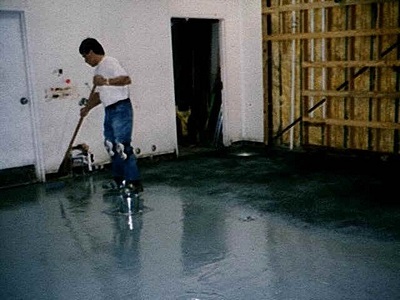
REASONS TO EPOXY PAINT YOUR CEMENT (GARAGE) FLOOR
Concrete (garage) floors are coated with pigmented epoxy resin systems for several reasons. These include:
1) to improve chemical resistance,
2) to prevent the concrete from sweating (epoxies are used for this application,
3) to impart a non-skid surface,
4) to seal the surface from moisture and/or reduce dust, and
5) for appearance sake.
|
Also Available - Epoxy Concrete Primer and Sealer (ESP 155 not for sale in CA) and Internal Concrete Sealer (Bio Vee Seal) leaves nothing on the surface. Do you need these under your epoxy floor coating? Call to find out. 603 435 7199 |
POSSIBLE PROBLEMS ASSOCIATED WITH EPOXY FLOORS
In some cases getting a suitable, long term bond between the concrete and the coating can become career or profit destroying task. Because of these potentially dreadful results, consider epoxy painting your slab or garage only if you really need to and only if you are willing to perform suitable surface preparation (which will help greatly in avoiding possible problems). It is often difficult to say exactly why a coating on a cement slab will fail (not stick, peel, blister, etc.). Reasons can include:
1) a layer of dust or dirt or the surface,
2) too smooth, oily or waxy a surface (from previous coatings or contaminants),
3) a damp surface,
4) surface salts or ions that are already present or forming/collecting (can be from surface waters, contaminants or from the concrete itself),
5) vapor pressure and or water flow within the porous concrete itself before, during, or after the coating has been applied, or
6) a weak surface layer of concrete (from either very old or very new concrete). Other problem situations include existing 'active' cracks and/or expansion joints. If you simply paint over them the coating will crack or peal when movement or shifting takes place.
SURFACE PREPARATION FOR EPOXY RESIN FLOOR PAINT
Surface preparation is often a judgment call based upon the location, condition and history of the existing concrete. Perhaps the surface needing the least preparation is the typical cement sidewalk outside your house that has been 'weathered' for several years and has never been oil stained, painted, etc. The existing factory or work floor is the floor that should cause you the most concern. Waxes, sealers, spills, dissolved salts, are all possible problems awaiting discovery.
Your best chance at a successful floor coating job in this case is to shot blast the floor, removing the top layer and providing a new, fresh surface profile. I would then water blast the surface and include a salt-removing agent. Finally wet vac the surface dry, sucking away the water, dust, and dissolved salts.
MODERN SOLVENT-FREE EPOXY COATINGS
Our company sells a line of solvent-free epoxies for floor coating. Solvent free epoxies have no strong fumes to deal with and their wet thickness equals their dry thickness. In other words, if you apply 20 mils of coating or fill in a tiny void with the wet epoxy, it will harden at 20 mils instead of shrinking and re-exposing any filled in cracks or voids. An 50% solvent (50% VOC) epoxy would require applying 40 mils of product to get 20 mils of dry epoxy. Of course, you probably cannot apply 40 mils in one coat so two or coats would be necessary (add in time and labor costs). Actually, it is even difficult to apply 10-20 mils of a solvent based coating without getting 'alligator' textures of peaks and indents with wet paint trapped underneath due to trapped solvent under the top layer of dry paint. No solvents also means nothing to soften or weaken existing coatings or finishes (such as the adhesive under floor tiles that are being encased or sealed in epoxy). These epoxies can also be applied to wet or damp (or even submerged) floors. Remember that moisture is one possible cause for floor coatings to fail.
COST OF EPOXY FLOOR PAINTS
As the above paragraph suggests, a $50/gallon, 50% solvent epoxy has the same amount of coverage as a $100/gallon, 0% solvent (0% VOC) product without the dangers and fumes of the solvent, nor the potential extra labor costs of solvent based product.
Epoxy paints generally sell for between $20 and $1,000 per gallon. To a degree, you get what you pay for. A premium grade epoxy could easily contain raw materials costing the manufacturer between $25 and $50-$60 per gallon. Like all products (but less than most) there is a several hundred percent market-up to pay for salaries, one or more layers of distributors and/or reps, marketing, packaging, R&D, overhead, profit, insurance, advertising, etc. To make very inexpensive epoxy means either using a lot of inexpensive solvents and/or inert, inexpensive fillers. This affects performance and quality.
EVALUATING EPOXY PAINTS
On a cost basis, evaluate your epoxy options on a cost per square foot, per dry mil basis. That removes the solvent factor (but not the fumes safety problem). Look for ease of application and reapplication. Beware of a problem know as 'amine blush' which leaves behind a waxy residue on the epoxy surface. Look for an ASTM E648 fire testing of the epoxy (or resin) system. Some epoxies require extreme care in getting the mix ratio 100% correct. Instead, look for a more 'field friendly' mix where being 'close' is good enough.
|
Concrete Sealing in a Nutshell There are 3 kinds of concrete sealers 1) inexpensive products that contain wax or paraffin dissolved in a solvent. Easy and cheap, but if you use these you will ever be able to coat the surface with any kind of paint or epoxy (you cannot paint on wax!). You cannot remove with solvents, which will just move the wax around. Use this kind of sealer and you are locked out of doing anything else forever. 2) Liquid sealers that are like paint and sit on the surface you are coating. No way you be be certain these will not peel or chip off and they may prevent you from top coating them with other products. 3) Internal concrete sealers, like our Bio Vee Seal. Bio Vee soaks into the exposed concrete and forms crystals within the concrete itself. It leaves nothing (except perhaps some tiny white crystals) on the surface. There is nothing to peel or chip and it leaves the surface as it was, allowing you full options to top coat with any product. Useful links: Bio Vee --- Concrete Sealers --- Industry article on sealing --- basement leaks/sealing --- Floor coating links or call 24/7 for help or to order - 603 435 - 7199 |
Brent L. who ordered our solvent free, commercial grade, Industrial Floor Epoxy emailed:
"A few weeks ago I ordered epoxy, color chips and UV Poly top coat for my garage (1700 sqf t). You may or may not remember an order of 15 gal of epoxy to Bismarck, North Dakota....
Anyway, I have half the floor done (half because of moving everything in my garage from one side to the other) and the floor looks awesome. People that have seen it are astounded, they've never seen anything like it because no one around here supplies industrial epoxy.
In high school (Calgary, Alberta) I used to work for a company that specialized in epoxy patching of concrete, so I am somewhat familiar with epoxies. I spent many months researching on the Internet what products are available and their cost. The product you have supplied is top notch and I have passed on your name to anyone that is interested."
"Thanks for all your advice, tips & moral support concerning my project. It turned out beautiful. Quality people backing a quality product is the only way to go!" Joe
ON-LINE CATALOG HOMEPAGE.
Inside Our non-marine, commercial, DIY Catalog:
Section A EPOXY PAINTS
corro coat FC 2100; water gard 300; CM 15; crack coat™; liqua tile 1172 potable water; water prime
Find Corro Coat FC 2100 and Water Gard 300 epoxy in our Best Selling - fix anything Catalog
Section B FLOOR EPOXIES (regular and non-skid products), SEALERS, ACCESSORIES
water bond (water based); industrial floor epoxy; bio vee seal; walnut shell; rough coat grit filled epoxy floor paint; epoxy clear top resi
Section C THICKENED EPOXIES - EPOXY PUTTIES, ETC.
wet/dry 700; splash zone A-788, epoxy cream; splash zone a-788
Find Wet Dry 700 epoxy in our Best Selling - fix anything Catalog
Section D CLEAR TWO PART EPOXIES
low V epoxy; basic no blush; ESP 155; Bio-Clear 810; epoxy clear top resin
Find Low V, Basic No Blush, and ES 155 epoxy in our Best Selling - fix anything Catalog
Section E NON-EPOXY PAINTS COATINGS SEALERS
Aluthane moisture cured urethane; Acrylic Poly UV Plus and other 2 part polys ; Capt. Tolley's creeping crack sealer; india spar varnish;
Find Aluthane in our Best Selling - fix anything Catalog
Section F MIX-IN ADDITIVES
fumed silica; fiber fill; micro balloons/micro-spheres; graphite; wood flour; EZ thick, rock flour;
Section G OTHER PRODUCTS
water activated pipe wrap; TA 661 solvent-free epoxy brush cleaner; fiberglass tape/cloth
Section H SURFACE PREPARATION PRODUCTS
Section I MISC. ACCESSORIES
short nap epoxy rollers; epoxy/stone deck resurfacing roller; 1 inch foam brushes; 2 inch bristle brushes; tongue depressors
Questions? / Phone order? / EMAIL / CALL 603-435-7199 EST / BUY ONLINE
GOOGLE SITE SEARCH - Click here Epoxy specific site search
Click here - YouTube video. Learn about Progressive Epoxy Polymers Inc.
EVAL4U - how to evaluate your epoxy vendor - CLICK HERE -
Legal Stuff / Returns
NOTICE: Legal notices, Terms of Service, warranty information, disclaimers, health warnings, etc. are required reading before using web site, ordering and/or using Products. Any such use and/or ordering, online or by telephone, shall constitute acceptance and knowledge of all such terms.
CLICK HERE to access these terms. Please note: Whenever you purchase from this web site, and with each new purchase, you are granting us full and complete permission to add you to our email newsletter list at our option. Accessing this web site, and/or purchasing our products, grants Progressive Epoxy Polymers, Inc. permission to add you to our email newsletter list. You may opt out from the newsletter at any time (link to do so can be found on the newsletter).RETURNS: call or email for authorization to return. Returns are subject to a 25% restock fee. Customer pays return shipping and must comply with federal DOT shipping requirement/labeling for hazmat epoxies under penalty of fines and legal action.
** Quick EMAIL / ph 603.435.7199 EST / Google SITE SEARCH / Buy On-line TWO STORES / Goto Contact PAGE / Web Product CATALOG / Progressive Epoxy HOMEPAGE / View our VIDEO / Navigation Bar REPLACEMENT / Data and MSDS PRODUCT INFO / Epoxy Guru HELP SITE / Top Selling Products - FAVORITES * *
Progressive Epoxy Polymers, Inc.
Located in No Sales Tax - New Hampshire (homepage)
EPOXY PAINTS AND RESIN SYSTEMS
1 AND 2 PART URETHANES - COATING SUPPLIES
"The Right Epoxy fixes Everything!"
Visit our Subject / Catalog contents PAGE
\