PROGRESSIVE EPOXY POLYMERS, INC.
Nothing but Quality Products at Good Prices, Great Customer Service, and Lots and Lots of Helpful Information
and NO SALES TAX - You are shopping in TAX FREE New Hampshire
APPREHENSIVE?
New to Epoxies? (They can be $$$). Let's talk (603 - 435 - 7199 or EMAIL) and put yourself at ease with a 1 on 1 conversation about your project, which products will work best for you, and how to use them. After purchase "handholding", support, and encouragement are also available anytime. We freely share our 20 plus years of epoxy experience and problem solving experience. If our owner, Paul Oman, is not available he will return your call quickly. Emails are answered all day long. Without potential customers, repeat customers, and friends like you that want some free, quick advice, New Hampshire based Progressive Epoxy Polymers, Inc., a Better Business Bureau member, would not exist. Thank you in advance and thank you for visiting epoxyproducts.com. We appreciate you interest in our company.
PRIMARY STORE LINK --- TOP SELLING PRODUCTS --- EPOXY GURU HELP SITE --- ALUTHANE MCU PAINT --- BASIC NO BLUSH (MARINE AND STONE EPOXY) --- BUY NO BLUSH
You won't learn if you don't ask! We share information 24/7 and earn your business!
HOT SPOTS: shippingContainers swimPool bartops cellarLeaks dataSheet barrierCoats pebbleDeck floors boats rot HELP/INDEX
EPOXY RESIN SYSTEMS
Fish eyes are where a coating pulls away from the underlying surface creating 'holes' or craters in the topcoat that go down to the bottom coating. They sometimes happen under certain conditions with epoxies. Two part polys (LPU) coatings are especially sensitive to fish eyes. Almost always they are caused by surface contamination, oil or wax, even in minute amounts.
Fish eyes - Craters in epoxy paint
resin surfaces
causes possible solutions to fish eyes in epoxy paint coatings
Your Host and Tour Guide:
Paul Oman, MS, MBA - Progressive Epoxy Polymers, Inc. (floor epoxies, marine epoxies, underwater epoxies, repair epoxies)
Member: NACE (National Assoc. of Corrosion Engineers), SSPC (Soc. of Protective Coatings)
"Professionals helping Professionals since 1994"
PROGRESSIVE EPOXY POLYMERS, INC.
|
PAGE AND SITE NAVIGATION |
|||||||||||||||||||||||||||||||||
Epoxy Education Links Page ====> This 'Linked To' Sub-Page
No Sales Tax applied. Save Money, you're shopping in Tax Free New Hampshire
MEMBER: Internet Epoxy Confederation (IEC - CLICK HERE TO VISIT) -- "Where Professionalism Still Matters"
We've been selling epoxy - marine epoxy (boat building - wood / fiberglass repair) industrial coatings - garage paint - underwater epoxies - thick putties - tabletop resins and supplies since the early 1990's |
Fish eyes are where a coating pulls away from the underlying surface creating 'holes' or craters in the topcoat that go down to the bottom coating. They sometimes happen under certain conditions with epoxies. Two part polys (LPU) coatings are especially sensitive to fish eyes.
They can be caused by surface contamination, oil or wax. They can also be caused by surface tension issues - - usually with simple raw/clear epoxy products (like when applying epoxy over a smooth/ slick surface like fresh glossy paint, along the edges of vinyl labels and decals etc
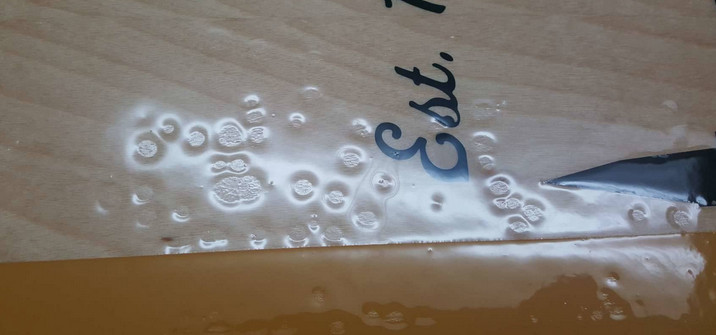
surface tension fisheyes on smooth surface
Our Bio Clear 8100 (tm) tabletop epoxy is a good example of surface tension fisheyes. If applied too thin over a very smooth surface it will fisheye. Some epoxies will fish eye more easily than others. Some of it is chemistry but also thickness and fillers come into play.
The bad news is that when epoxies fish eye due to surface contamination there is no simple fix. Solvent washing
will often not fix the problem. Presumably the solvents just move the wax / contaminants around. More epoxy doesn't help,
the fish eyes/craters just telegraph through the new layers of epoxy. I don't have an exact fix for fish eyes in
epoxy. It happens rarely and never seems to happen when I intentionally try to product it. My best fix ideas are:
Watch the epoxy while it sets up and then ‘brush out’ the fisheye as it forms.
A possible easier solution (will it work?) is to spray the surface with clear spray paint and then apply be clear epoxy over it when the spray paint is still tacky. This provides some ‘friction’ to the surface and might prevent the dimples and fisheyes from forming.
A leading cause of oil surface contamination affecting epoxies has to do with oil based stains used on wood. It
takes the 'oil' in the stains several weeks to dry or evaporate away so that it doesn't potently cause fisheyes
in any epoxy coat applied on it. It has happened to me (using our Low V epoxy) and I have had others report it
happening (using our marine epoxies, I think) but I have not been able to duplicate it when I wanted to test some
possible ways to 'fix' the fisheyes.
We really appreciate you visiting PROGRESSIVE EPOXY POLYMERS, INC. and our web site: EPOXYPRODUCTS.COM. Take advantage of the CONTACT links on this page to ask questions about our products and/or your projects. You can stay in touch with us via our NEWSLETTER (link on our contact page) which is emailed every 6-8 weeks.
This current page is all about:
Fisheyes - Craters in epoxy paint
resin surfaces
causes possible solutions to fisheyes in epoxy paint coatings
|
|
WOW! 35% - 40% of all daily online or telephone orders are from existing customers. That's an amazing 'REPEAT CUSTOMER" number. |
|
603 - 435 - 7199 ANYTIME 24/7 FOR HELP OR ORDERS |
|
|
|
|
Reports of alkyd enamel drying issues when applied over ESP 155 - see enamel.html .
###
Epoxy Only Web Google Search
#1) Google
Everything Epoxy Searches
#2) Google
Marine Epoxies Searches
#3)Google
Floor Epoxy Searches View
our Progressive Epoxy Products, Inc.


 |
 |
 |
||
|
site master |
protagonist |
ground zero |
Fish eyes - Craters in epoxy paint
resin surfaces
causes possible solutions to fish eyes in epoxy paint coatings