
PROGRESSIVE EPOXY
POLYMERS, INC.
GOOGLE SITE SEARCH - Click here
Click here - YouTube video.
Nothing but Quality
Products at Good Prices, Great Customer Service, and Lots and Lots of Helpful
Information
and NO SALES TAX - You
are shopping in TAX FREE New Hampshire
EPOXY-ONLY WEB SEARCH
CALL 603-435-7199 (or
email).
We are the only
technology based coating/epoxy/resin company that
actively encourages your phone calls, not just
during our East Coast work hours but also
after/before hours, evening, weekends and even
holidays. We're available when you are. We form a
personal relationship with our customers and freely
share technical information, how to-advice, product
information and tips-and-tricks. Speak with a
non-salesman technical professional with over 25
years of experience in the resin/coating/epoxy
industry (no newbie staffer on the phone lines!).
Floors, tables, boats, leaks, rot repair. We handle
it all!
We are an 'always available,'
one-on-one, technical/scientific, coating company (watch
our video). We are NOT one of those fluffy/slick mass sales firms the
dominate the internet selling cheap third party (made in China???), low end
epoxies and coatings with no real knowledge of what they are selling and
quotas to sell to as many people as possible. 603-435-7199 (east coast time).
PRIMARY
STORE LINK ---
TOP SELLING
PRODUCTS --- EPOXY GURU HELP
SITE ---
EPOXY DATA SHEETS
EPOXY RESIN SYSTEMS - BASICS
"The Right Epoxy Fixes Darn Near Everything!"
Epoxy Paints 101 -
The Epoxy Paint Info
- Help Page
Epoxy Paints come in lots of 'flavors.' The purpose of this page is to
get you up to speed about epoxy paints and to compare the different epoxy paints offered by Progressive Epoxy Polymers
(they also sell marine epoxies, underwater epoxies, epoxy putties, fillers, etc.)

EPOXY resin paint basics - Info
Epoxy Paint 101
Epoxy Paint Resin Systems come in many types - Learn - help about 2 part epoxy
floor paint systems
Your Host and Tour Guide:
Paul Oman, MS, MBA - Progressive Epoxy Polymers,
Inc.( floor epoxies,
marine epoxies, underwater epoxies, repair epoxies) since 1994
Member: NACE (National Assoc. of
Corrosion Engineers), SSPC (Soc. of Protective Coatings)
Board member:
Friends of the Suncook River
- 501(c)(3) non profit ----- Founder: Friday
Night Paddlers .
"Professionals helping Professionals"
PROGRESSIVE EPOXY
POLYMERS, INC.
largest selection of epoxy paints on
the internet
|
PAGE AND SITE
NAVIGATION |
Epoxy Resin Education Links Page ====> This 'Linked
To' Epoxy Paint Sub-Page
FYI: catalog pages are blue (marine) or yellow (home/indust),
info pages are green, product pages are purple, core pages are gray
Using this site means you accept its terms
and conditions of use
|
NOTICE: Legal notices, Terms of Service, warranty information, disclaimers, health warnings,
etc. are required reading before using website, ordering and/or using Products. Any such use and/or ordering, online
or by telephone, shall constitute acceptance and knowledge of all such terms.
CLICK HERE (www.epoxyproducts.com/legal.html) to access these terms. |
MEMBER:
Internet Epoxy Confederation (IEC -
CLICK HERE TO VISIT) -- "Where Professionalism Still Matters"
|
Epoxy Paints come in lots of 'flavors.' The purpose of this page is to
get you up to speed about epoxy paints and to compare the different epoxy paints offered by Progressive Epoxy Polymers
(they also sell marine epoxies, underwater epoxies, epoxy putties, fillers, etc.)
What separates general purpose epoxy paints (and non-epoxy paints) for epoxy and non-epoxy floor paints, plain
marine resins, or even water, is their thixotrophic properties. The term has to do with internal gelling of the
paint. Thixotrophic additives, such as fumed silica, give the coating the ability to 'gel' after application. This
means when applied to a vertical surface, such as a wall, the coating will be as thick at the top of the wall as
it is at the bottom of the wall. Regular marine epoxy, floor paints/epoxies, and water, are non-thixotrophic and
if applied to a wall would tend to flow or slump to the bottom of the wall, leaving very little of the coating
near the top of the wall.
Epoxy paints, such as those offered by Progressive Epoxy Polymers, Inc., are used for marine barrier coats, equipment
coating, pipelines, tanks and sumps, wastewater applications, etc.. The advantages of epoxy paints is that they
can handle full time immersion, strong chemicals, and are very impermeable as well as tough. Many are solvent free
so wet thickness will equal dry thickness (cracks will not reappear as the epoxy cures) and they are nearly odorless.
Some can even be applied underwater. The disadvantages of epoxies are that they tend to be brittle, quickly yellow
in sunlight (white becomes a creamy color, light blue becomes light green, etc.) and lose their shine in sunlight.
The yellowing and loss of gloss (even chalking in some cases) is due to the affect of UV on ALL epoxies (some epoxies
will yellow in days, others take weeks but they all do eventually).
The epoxy paints available from Progressive Epoxy Polymers come from several different formulators and are suitable
both marine and industrial/commercial applications including barrier coats on boat hulls.
The major differences between
the different epoxy paints are:
Epoxy Color - although in
large volumes (15 - 60 gallons depending upon the formulator) custom colors are usually available - but remember
that epoxies yellow. Generally our epoxy paints are available only in one color, which varies from product to product.
Viscosity/fillers - solvent free epoxies tend to be somewhat thick, but
all the epoxies considered here are rollable or brushable. (Progressive also sells thicker epoxies). Some are thinner
than others making them slightly easier to brush or spray apply. Our FC 2100 epoxy contains both Kevlar (tm) micro
fibers and feldspar ceramic which complicates things if the product is to be spray applied. Generally many of these
products can be applied at up to about 20 or 25 mils by brush or paint pad, however if applied by paint roller
coating thickness is generally about 6-8 mils because the back side of the roller tends to lift (remove) a lot
of the epoxy that the front end of the roller puts down. For more on this - CLICK HERE (www.epoxyproducts.com/roller.html) . Note
that at 16 mils coverage is 100 square feet per gallon - at 8 mils it is 200 square feet per gallon.
Epoxy Pot life - the amount
of time after the two epoxy components are combined that they can be used before they begin to harden. Pot life
is greatly affected by temperature (doubling or halfing every 18 degrees F or 10 degrees C) and by the amount and
concentration of the epoxy. 12 ounces of epoxy in a cup will have a much shorter pot life than 12 ounces spread
out on a floor or 3 ounces of epoxy in a cup. In really hot weather an epoxy with a long pot life may be necessary
because an epoxy with a more 'normal' pot life may not provide enough working time (perhaps only 10 minutes or
so). In cold conditions a 'fast' or short life epoxy may be necessary because the cold conditions will greatly
slow down the epoxy reaction and stretch out the pot life considerably.
Epoxy Price - this is self
explanatory.
Epoxy Shipping Restrictions
- Most epoxies (actually just the curing agent - part B), and all products containing solvents are considered hazmat
to ship. Generally these products can be shipped 'ground' without problem or special charges, but they are nearly
impossible (or too expensive) to ship, especially in small amounts, by air or outside the USA. If you need air
shipment or live outside the USA consider only the non hazmat classified coatings.
We really appreciate
you visiting PROGRESSIVE EPOXY POLYMERS, INC. and our web site:
EPOXYPRODUCTS.COM. Take advantage of the CONTACT links on this page to ask
questions about our products and/or your projects. You can stay in touch with us
via our NEWSLETTER (link on our
contact page) which is
emailed every 6-8 weeks.
This
current page is all about:
EPOXY RESIN SYSTEMS - BASICS
EPOXY resin paint basics - Info
Epoxy Paint 101
Epoxy Paint Resin Systems come in many types - Learn - help about 2 part epoxy
floor paint systems
|
 |
WOW!
35%
- 40% of all daily online or telephone orders are from existing
customers. That's an amazing 'REPEAT
CUSTOMER" number. |
|
EPOXY-ONLY WEB SEARCH
|
603 - 435 -
7199 ANYTIME 24/7 FOR HELP OR ORDERS |
|
 |
|
Hierarchy of Epoxy Paints, Epoxy Resins and Coatings
It has been our experience that epoxy paints fall into several price/application groupings that may not be obvious
to most end users. These groupings help explain why epoxy paint prices seem to fall all over the place.
I) ‘A TEAM’ PREMIUM EPOXIES:
These are the really good, high-end epoxies. There’s lots of ‘wiggle room’ here, but general characteristics of
epoxies in this group often are: solvent-free (0% VOC); non-hazmat to ship; suitable for full time immersion, often
use a cycloaliphatic curing agent; often can be applied
underwater. Might be a novolac based resin, might be potable water (NSF 61) or nuclear (DBA) approved. Applications
include: tanks, pits, sumps, pilings, marine hull barrier coats, waste water, manholes. Prices: generally about
$80-$125 per gallon.
II) ‘B TEAM’ EPOXIES:
Many (not all) of these epoxies contain solvents, which generally reduce the physical properties of these epoxies.
They are often used as ‘tie coats’ and general maintenance applications, such as coating machinery, tanks, walls,
misc. equipment, etc. Coal Tar epoxies would commonly
fall into this group. Prices generally in the $50-$75 per gallon range
III) FLOOR EPOXY PAINT:
Generally self leveling (non-thixotropic) versions of the “B Epoxies” but can sometimes also include the “A Premium
Epoxies” and priced about the same. Price: $50-$90 gallon.
IV) EPOXY RESINS/MARINE EPOXIES:
Usually solvent free epoxies from the ‘floor epoxy’ group, but without the pigments. Savings from not using the
pigments (and associated blending) is probably in the order of $5 per gallon, so the ‘real’ price should be about
$40-$60 per gallon, but often the marine (boating) link adds $20 to the pockets of the vendors.
V) EPOXY PRIMERS AND SEALERS:
Generally solvent thinned versions of the marine/resin epoxies, with or without pigment. The amount of solvent
used might be 20% to 70%. Cheap to make and cheap in volume for contractors, but small users pay a premium for
the blending, packaging, marketing, and the often ‘marine’ label. Still, coverage is excellent so the cost per
square foot is still reasonable. Prices about $45 to $60 per gallon.
 |
|
 |
|
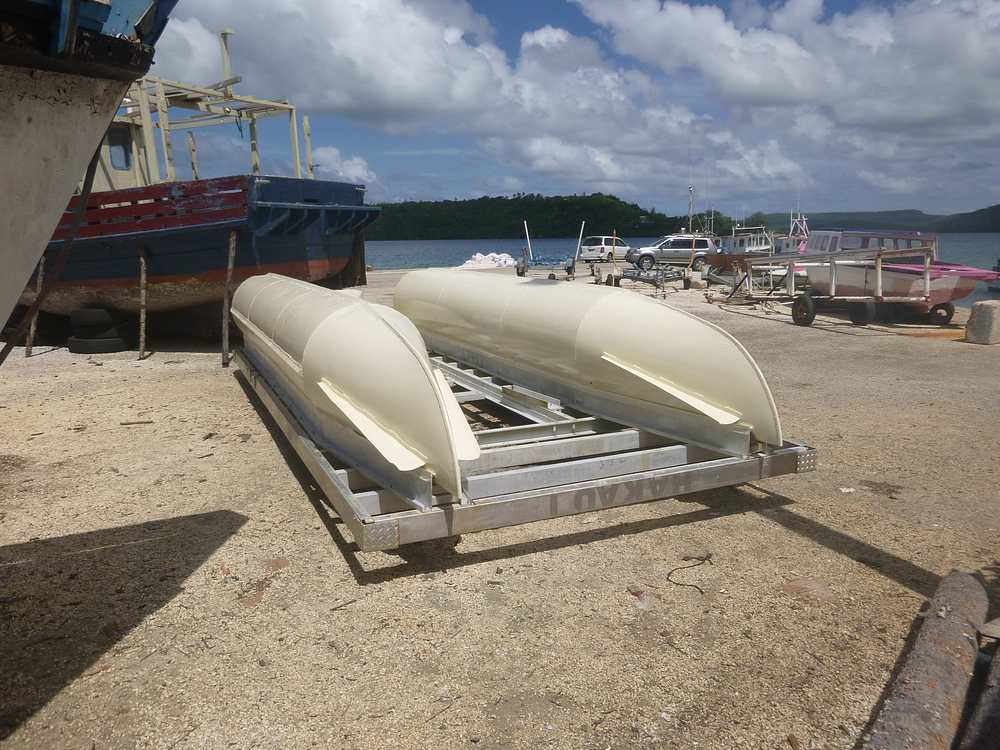
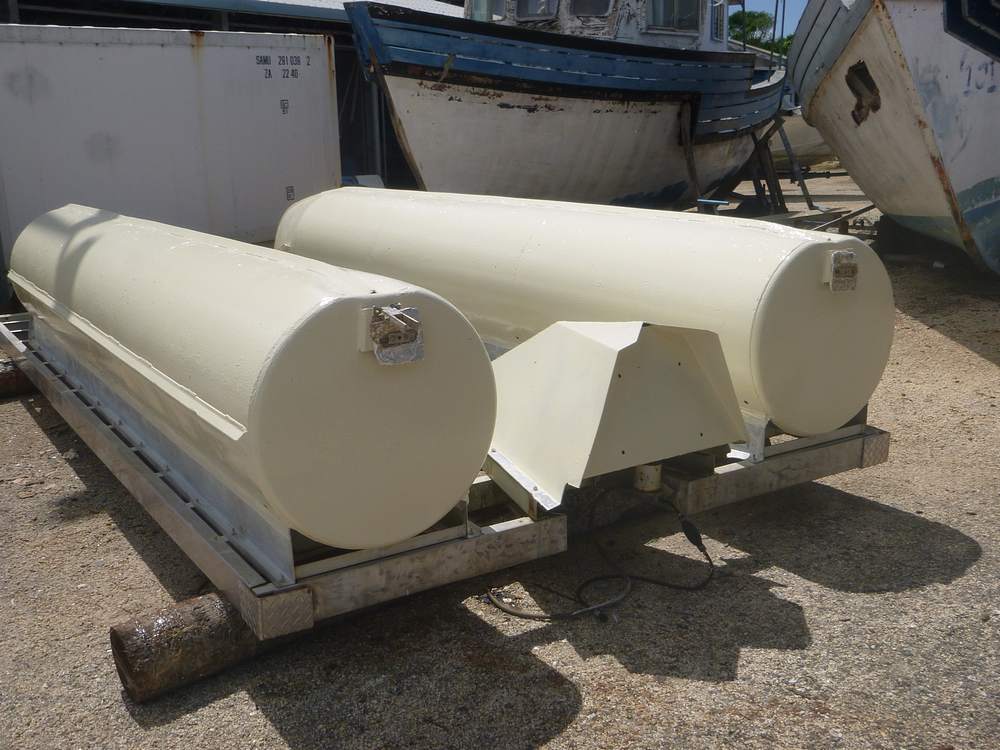
Tonga Based Dive Boat Pontoons
Refurbished with white
Water Gard 300(tm)
Epoxy Paint |
|
Please take a moment to
complete
a ten question multiple
choice
EPOXY
SURVEY |
|
CLICK HERE |
Two Part
Epoxy Product Groups:
(EVERYTHING-EPOXY.INFO --- Intro to
basic epoxy resin types )
SPECIAL NOTE: solvent free epoxies (0% VOC) are generally
considered to be self priming, (no primers needed). However, without solvents, there bond is strictly a surface
event so dust, weathering, very dry surfaces (such as repaint putties) etc. can provide a less than perfect surface
for them to bond with. A solvent based epoxy primer, with the solvents penetrating the surface a little bit, can
provide a better, well bonded, fresh, epoxy surface for a solvent free epoxy to adhere to.
Progressive Epoxy Polymers
offers two primers: CM 15™ high build, low solvent epoxy
paint - primer, -- low build, low solvent epoxy primer, -- ESP 155™ low solvent penetrating clear epoxy primer
(not for sale is Southern Calif.).
|
FIND THIS/THESE
PRODUCT(S)
(click
here)
IN ONLINE
CATALOG PAGE
AND ONLINE
STORE FRONT |
|
Epoxy "Stab Brush" -- "Regular Brush" |
|
Use with
products on this page |
|
buy separately or
include with your order |
|
 |
|
STAB BRUSH
- 3 inch wide with 3/4 inch bristles. Most epoxies are too thick for
a regular brush. Stab brushes allow you to push and move the epoxy
around and 'stab' or poke it into cracks, voids, and corners |
| REGULAR BRUSH - 2
inch wide and extra thick with synthetic bristles. Use with varnish,
paints and thin epoxies. Priced for disposable use. |
|
Find Stab Brushes
and Regular Brushes in our
MARINE CATALOG
or in our
HOME/COMMERCIAL CATALOG |
|
Goto our 3rd party storefront
and purchase in the
MISC
SECTION |
|
Epoxy
Floor Coatings - Sampler Kits
1) NEW Epoxy Floor/
Deck non slip coating (ROUGH COAT (TM) FLOOR EPOXY) Check out the 8 oz test kit of
Rough Coat (tm) - a tan colored solvent based epoxy floor
coating with non slip grit already mixed in. Standard unit size is
one gallon which covers about 160 sf. Texture is suitable for bare
feet. Use on boat decks, garage floors, shower areas etc.
This product is
featured on the GreatThings4u.com website.
2) Solvent Free Industrial Floor Epoxy - 48 oz test kit
of IFF in beige or light gray. Tired of the low end stuff sold
in mass market box stores or hard sell epoxy flooring web sites
run by a marketing major and staffed with ex-shoe salesman just
interested in your money? Check out our industrial - commercial
(you can buy 15 gallon units), solvent free, Industrial Floor
Epoxy (even the product name is simple, no frills labeling). Use
with or without chips (order separately - picking colors and
percentages), and with or without clear epoxy or poly
intermediate or topcoats. Shop like a Professional - where you
pick and select what you need.
This product is
featured on the
Best Epoxies website.
CLICK HERE
(floor epoxy paint options)
to see these products in our online catalog.
|
"Best" Epoxy Product Winners
| |
|
|
|
 |
Boat Repair - Marine Epoxy
Massive Link Site
<====
click |
Epoxy Floors - Options & Products
Massive Link Site
click
====>
|
 |
|
Epoxy 101
Epoxy Education Link Site
click
====> |
 |
 |
Home Repairs With Epoxy
Massive Epoxy Fix Link Site
<====
click |
 |
Arron's Directory of
Epoxy Web Sites (part 1)
<====
click |
Arron's Directory of
Epoxy Web Sites (part 2)
click ====> |
 |
|
Epoxy
Home Page
click
====> |
 |
 |
Epoxy Index Page
Find Info By Subject
<====
click |
|
 |
Photo Gallery
Neat Boat Pictures
<====
click |
Copulas of the Suncook River Valley - Central NH
click ====> |
 |
|
Epoxy Questions?
Ask Prof. E. Poxy
click ====> |
 |
 |
Contact Us
or Order Epoxies
<====
click |
 |
DIY Poured
Epoxy Bar Tops
<====
click |
Outdoor Epoxy Pebble Deck
Re-Coat / Repair
click
====> |
 |
| |
|
|
|
Progressive Epoxy Polymers, Inc.
www.epoxyproducts.com

EPOXY resin paint basics - Info
Epoxy Paint 101
Epoxy Paint Resin Systems come in many types - Learn - help about 2 part epoxy
floor paint systems
ON-LINE
CATALOG HOMEPAGE.
Inside Our non-marine, commercial, DIY Catalog:
corro coat FC 2100; water gard 300; CM 15; crack coat™;
liqua tile 1172 potable water; water prime
Find Corro Coat FC
2100 and Water Gard 300 epoxy in our Best Selling - fix anything
Catalog
water bond (water based); industrial floor epoxy;
bio
vee seal; walnut shell; rough coat grit filled
epoxy floor paint; epoxy clear top resi
wet/dry 700; splash zone A-788, epoxy cream; splash
zone a-788
Find
Wet Dry 700 epoxy in our Best Selling - fix anything
Catalog
low V epoxy; basic no blush;
ESP
155; Bio-Clear 810; epoxy clear top resin
Find
Low V, Basic No Blush, and ES 155 epoxy in our Best Selling - fix anything
Catalog
Aluthane moisture cured urethane;
Acrylic Poly UV Plus
and other 2 part polys ;
Capt.
Tolley's creeping crack sealer; india spar varnish;
Find Aluthane in our Best Selling - fix anything
Catalog
fumed silica; fiber fill; micro
balloons/micro-spheres; graphite; wood flour; EZ thick, rock flour;
water activated pipe wrap; TA 661 solvent-free epoxy brush cleaner; fiberglass tape/cloth
short nap epoxy rollers; epoxy/stone deck resurfacing roller; 1 inch foam brushes;
2 inch bristle brushes; tongue depressors
Questions? / Phone order?
/
EMAIL / CALL 603-435-7199 EST /
BUY
ONLINE
GOOGLE SITE SEARCH - Click here
Epoxy specific site search
Click here - YouTube video.
Learn about
Progressive
Epoxy
Polymers
Inc.
EVAL4U
- how to evaluate your epoxy
vendor -
CLICK HERE -
####