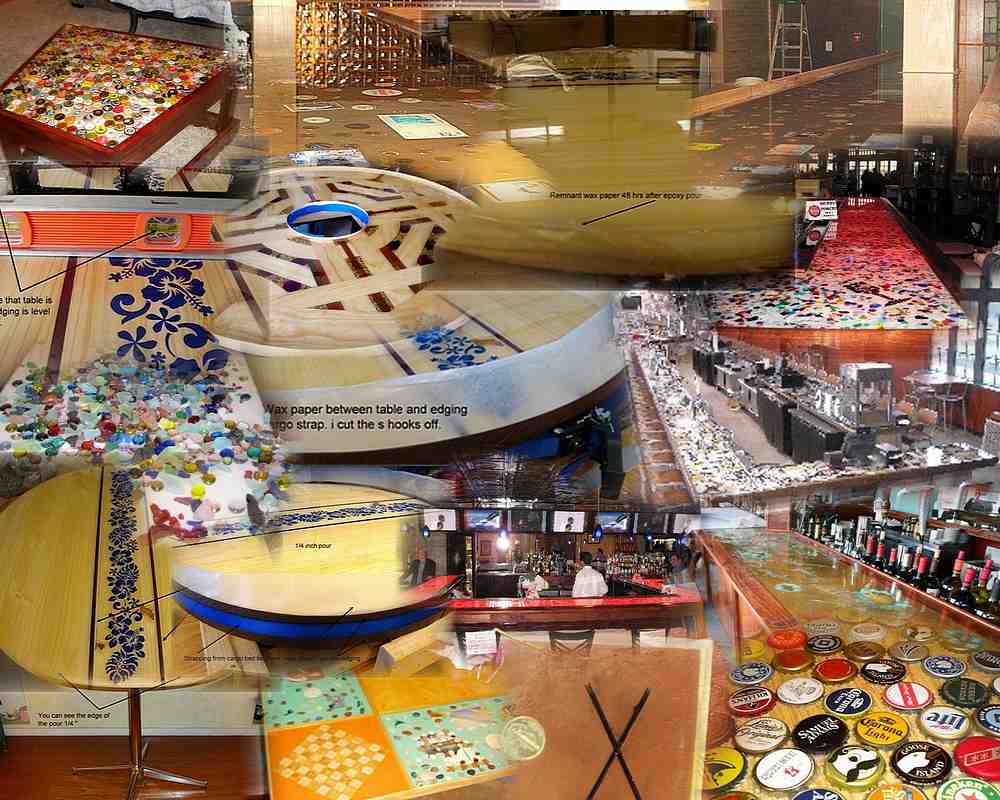
Professional bars done with Bio Clear 810
the ONLY cycloaliphatic system and no nonyl phenol
CYCYLO ALIPHATIC EPOXIES
Progressive Epoxy Polymers, Inc.
Pittsfield, NH 03263
Quick EMAIL / ph 603.435.7199 EST / Google SITE SEARCH / Buy On-line TWO STORES / Web Product CATALOGS
"We are the only company that shows you who we are (watch our 2 min video); special chemical advantages of some of our epoxies (nonyl free epoxies -- epoxy adducts -- cyclo-aliphatic epoxies); and who offers 24/7/365 email support for help, questions, and/or orders. We go the extra mile for your respect and support."
| LEARN ABOUT: |
| Cycloaliphatic epoxies |
| Epoxy adducts |
Your Host and Tour Guide:
Paul Oman, MS, MBA - Progressive Epoxy Polymers, Inc. - (floor epoxies, marine epoxies, underwater epoxies, repair epoxies)
Member: NACE (National Assoc. of Corrosion Engineers), SSPC (Soc. of Protective Coatings)
"Professionals helping Professionals since 1994"
Benefits of Cyclo-aliphatic
Epoxies: * improved 'weatherability' -sometimes used on
pebble stone decks * water/moisture tolerance * resistance to blushing and water spotting * better chemical resistance. The ring structure (the 'cyclo' part) also provides (in many cases) a bit more
structural 'stretch' than the traditional straight chain curing agent. This provides for better 'impact' resistance
(note: 'hard' epoxies, on the other hand, offer better abrasion resistance). In the 50 or so years that epoxies have been in existence, one of the technological advances was the introduction
of cycloaliphatic curing agents ten or twenty years ago. For many years it was the 'secret weapon' of epoxy formulators.
The addition of cycloaliphatic curatives in the Part B (hardener or curing agent) of epoxy resin systems greatly
improves the epoxy. Usually the Part B is a blend of curing agents selected due to properties and/or price. Generally,
cycloaliphatic curing agents (and their are several) are more expensive than the regular/standard curing agents
(by 25 - 40% or so). Cycloaliphatic Epoxy Chemistry Cycloaliphatic chemistry explained by "The Chemist"
- the hands-down expert on epoxies - in a 2/18/03 post on the Wooden Boat Forum -- The conclusion is that the most or all of the top grade, exterior quality, high performance epoxies use a Part
B curing agent blend consisting partially of cycloaliphatics. Thus, checking the MSDS of the Part B side of an
epoxy product for mention of cycloaliphatics is a good way to judge the quality and performance of the epoxy. Cycloaliphatic Epoxies Explained on the Web source:
https://www.vanguardconcretecoating.com/types-of-epoxy-resins.htm
The ring structure (the 'cyclo' part) also provides (in many
cases) a bit more structural 'stretch' than the traditional straight chain
curing agent. This provides for better 'impact' resistance (note: 'hard'
epoxies, on the other hand, offer better abrasion resistance). Most or all of the top grade, exterior quality, high
performance epoxies use a Part B curing agent blend consisting partially of
cycloaliphatics.
Cycloaliphatics are known for their:
The benefits and higher quality of cycloaliphatic epoxies becomes more obvious if you perform an Internet search
for "cycloaliphatic epoxy". You'll find nearly all the search results refer to cycloaliphatic epoxy electrical
insulators in comparison to traditional ceramic glass insulation. You'll find, after a bit of reading, that the
insulator industry likes the long lasting, weatherability of cycloaliphatic epoxy insulators and think them suitable
for long term outdoor exposure. There is no mention of non-cycloaliphatic epoxies.
"The cycloaliphatic structure refers to a six-member carbon-atom ring in the backbone of the curing agent
instead of carbon-carbon linkages between amines in some other curing agents such as
xxxxxxxx. The cycloaliphatic
curing agents have the amine groups connected to the rings. Both use Diglycidyl ether of Bisphenol-A as the major
component of the epoxide curing agent, and both contain benzyl alcohol, a volatile plasticizer which acts as a
molecular lubricant and facilitates curing [although systems with cycloaliphatic curing agents contain much more,
typically 20-30%, as they simply do not cure more than about half-way at room temperature without it.]
While the cycloaliphatic ring is resistant somewhat to UV degradation, more that the carbon-carbon linkages between
amines in some other types of curing agents, both contain the aromatic ring structure of diglycidyl ether of Bisphenol-A,
which breaks down fairly readily on UV exposure, and both contain amines; these give both molecular breakdown and
yellowing all by themselves.
None of these structures should be considered UV-stable, even though the cycloaliphatic structures are better than
the aliphatic amine-structures in that regard."
Cycloaliphatics epoxy systems generally cost about 25% more than ordinary epoxies. In many applications they are not necessary. But they certainly are for clear table tops and bar tops. SEE BELOW
Cycloaliphatic Epoxies - A must have in table and bar top applications
IF YOU DON'T USE CYCLOALIPHATIC BASED BIO CLEAR 810 ON YOUR POURED BAR TOP (OR THE BASIC NO BLUSH TABLE TOP - AN EPOXY ADDUCT WHICH ALSO HAS SPECIAL ADVANTAGES) - TABLE TOP YOU'LL REGRET IT BIG TIME. HERE'S WHY....
A commercial epoxy pour contractor recently used our Bio Clear 810 to replace a badly yellowed epoxy poured covered logo on the INSIDE floor of regional airport terminal with our 'almost no yellowing' Bio Clear 810 (cyclo-aliphatic epoxies to the rescue!)
A commercial epoxy pour contractor recently used our Bio Clear 810 to replace a badly yellowed epoxy covered logo in the INSIDE floor of regional airport terminal with our 'almost no yellowing' Bio Clear 810 (cyclo-aliphatic epoxies to the rescue!) This is a good example of why you want to use only a cyclo-aliphatic epoxy for your bar top. The other clear epoxies sold for table tops suffer from bad (excessive?) yellowing (and I bet they don't even mention it on their web sites). Because of the yellowing, it is generally not a good idea to have a poured epoxy table / bar outside in the sun, but if you do - use our cycloaliphatic epoxy and keep it covered when not in use.
This is a good example of why you want to use only a cyclo-aliphatic epoxy for your bar top. The other clear epoxies sold for table tops suffer from bad (excessive?) yellowing (and I bet they don't even mention it on their web sites).
Don't be like the first contractor that just poured some cheap clear epoxy over the airport logo and thought they did a good job. It looked fine to start with and the contractor made a few extra dollars using generic clear epoxy. Too bad. The airport was lucky they could redo their badly damaged cheap epoxy mistake. Most folks cannot redo their special poured epoxy table top.
NOTE: Because of the yellowing, it is generally not a good idea to have a poured epoxy table / bar outside in the sun, but if you do - use our cycloaliphatic epoxy and keep it covered when not in use.
Cycloaliphatic Epoxies - Not needed in floor epoxies
Why You Don't Want, Or Need, A Cycloaliphatic Epoxy Floor Paint
PART 1
There are probably dozens of companies (of dubious quality) selling epoxy floor paints over the Internet. Only one of them that I know of promotes a cycloaliphatic epoxy floor paint. Why only one? If it was such an advantage, other epoxy floor vendors would also offer cycloaliphatic epoxy floor paint. The answer is that at best it is a useless option, at worst, it is a scam.
What are Cycloaliphatic epoxies? Two part cycloaliphatic epoxies use a special cycloaliphatic curing agent or hardener with the standard epoxy (part A) resin. This curing agent (most part B curing agents are actually a blend of different curing agents) improves some of the ordinary epoxy properties. These include outdoor weatherability, better chemical resistance (ordinary epoxies already have outstanding chemical resistance), and better moisture tolerance during application.
Note: cycloaliphatic epoxies are good for things like table top and bar top epoxies and are also used modern telephone pole wire insulators.
Why You Don't Want, Or Need, A Cycloaliphatic Epoxy Floor Paint
PART 2
None of the benefits/gains associated with cycloaliphatic epoxies are needed in a floor epoxy paint. Simply put, it is unnecessary overkill. And the downside is that it increases the cost by about 20%. If the price of company's cycloaliphatic epoxy paint is NOT 20% more expensive than its competitor's non cycloaliphatic epoxy it suggests three things: 1) the company doesn't want to make a profit and stay in business, 2) they are cutting costs in some other way or using cheaper quality resins, pigments etc. (generally not a good thing), or 3) they are only adding a very tiny amount of cycloaliphatic curing agents into their part B blend of curing agents - just enough to claim cycloaliphatic status (sort of unethical).
So why would a company claim the cycloaliphatic floor epoxy paint niche? I can think of only two reasons. 1) trying to impress unsuspecting customers, or 2) the company doesn't have anyone on staff that is really an epoxy expert and coatings professional.
Your best epoxy floor option? A 100% solids epoxy like Industrial Floor Epoxy (tm) -
Learn more. Visit a massive web site of epoxy floor links
Cycloaliphatic Epoxies offered
by Progressive Epoxy Polymers Inc:
SCROOL DOWN TO VISIT EACH ONE
* Premium No Blush --- high end marine epoxy
* Bio Clear 810 --- top selling table top epoxy
* Corro Coat FC 2100A --- kevlar (tm) ceramic epoxy paint - jell - repair - gap filling (apply underwater) epoxy
* Wet Dry 700 --- kevlar (tm) ceramic epoxy paste - jell - repair - gap filling (apply underwater) epoxy
* ESP 155 ---- epoxy sealer and primer (not for sale in california
* Water Gard 330 --- epoxy paint - can be applied underwater - for marine barrier coats, underwater swimming pool repair, manholes
Premium No Blush (tm)
- top of the line marine epoxy (non hazmat to ship - can be air shipped worldwide)
find in catalog
|
Why Premium No Blush epoxy is the BEST in its class: 1) Can be shipped by air 2) cycloaliphatic epoxy system 3) formulated with no nonyl-phenol for more perfect finish 4) amber curing agent brings out the wood color 5) strong user support / feedback 6) 24/7 support
|
COMMON APPLICATIONS: high end marine epoxy resin, table tops
Bio Clear 810 (tm) - top selling professional bar and table top epoxy (requires 1/4 inch pours into a 'pan' setting)
Professional bars done with Bio Clear 810
the ONLY cycloaliphatic system and no nonyl phenol
Corro Coat FC 2100A (tm) - kelvar (tm) ceramic reinforced epoxy paint that can be applied to wet or damp surfaces - learn more ---- See in our Favorites Site
|
Why Corro Coat FC 2100A epoxy is the BEST in its class: 1) Gap filling Kevar (tm) based epoxy paint 2) can be applied underwater 3) special high end curing agents allow shipping by air 4) no nonyl phenol 5) cycloaliphatic formulation 6) no odor or solvents 7) strong user support / feedback 8) 24/7 support |
COMMON APPLICATIONS: marine barrier coat, leak repair in tanks pits and basements, gap filling paint on rough pitted surfaces, underwater application on pilings, sheet piling
Wet Dry 700 (tm) - kelvar (tm) ceramic reinforced epoxy paste or gel (about as thick as cake icing or joint compound. Can be applied to wet or damp surfaces - See in our Favorites Site
Jeff (1/2013) "I cannot believe how incredible this Wet Dry 700 is. It's revolutionary. The original repair to my storm shelter would have lasted years if the shelter would just stop shifting around in the ground. DON'T STOP SELLING THIS STUFF."
|
Why Wet Dry 700 epoxy is the BEST in its class: 1) An apply underwater superior resin system 2) cycloaliphatic epoxy system 3) Kevlar (tm) reinforced epoxy 4) not too thick, not too thin, patch and repair gel (like cake icing) 5) strong user support / feedback 6) 24/7 support
|
COMMON APPLICATIONS: Patching holes voids and leaks, underwater repairs (pools, boats, tanks), rot repair, gluing, pipe wraps, vertical/overhead fiberglass repairs, marine blister repair
ESP 155 (tm) - solvent based epoxy sealer and primer often used on fiberglass, wood, concrete and under other epoxy coatings - See in our Favorites Site
"I bought some ESP 155 as a prime coat and used your India Marine Spar Varnish on top - unbelievably good! Forty year old mahogany seats in my dingy look as good as the brand new gunwales." John 1/15
|
Why ESP 155 epoxy sealer and primer is the BEST in its class: 1) Uses superior CYCLOALIPHATIC curing agents and epoxy ADDUCT formulation 2) solvent based for better penetration 3) moisture tolerant, very low viscosity 4) strong user support / feedback 5) 24/7 support |
COMMON APPLICATIONS: concrete wood and fiberglass sealer and bond enhancer, base coat under varnish and 2 part poly coatings, base coat and sealer on wood and old fiberglass boat hulls
Water Gard 300 (tm) - light blue or white epoxy paint often used as a marine barrier coat and for apply underwater swimming pool repairs (sump, water treatment facilities, manholes in industrial settings) - learn more
"Just wanted to let you know that the white Water Gard 300 epoxy I purchased to repair my fiberglass swimming pool underwater worked great!!!! Did test spots on shallow area and steps, and It looks like it did 31 years ago. Going to tackle the deep area next. Thank You So Much!! I will share with others!" ----- Helen from LA.
|
Why Water Gard 300 epoxy is the BEST in its class: 1) Performance boosted epoxy ADDUCT 2) can be applied underwater 3) cycloaliphatic formulation 4) not too thick, not too thin, 1 coat epoxy paint 5) special high end curing agents allow shipping by air 6) strong user support / feedback 7) 24/7 support |
COMMON APPLICATIONS: marine barrier coat, underwater swimming pool repair, commercial grade blue/white epoxy paint, fish tanks, pits, manholes, water treatment facilities
Learn More about Epoxy
Basic Properties - visit our Epoxy 101 web site
GOOGLE SITE SEARCH - Click here Epoxy specific site search
Click here - YouTube video. Learn about Progressive Epoxy Polymers Inc.
EVAL4U - how to evaluate your epoxy vendor - CLICK HERE -
"The Right Epoxy fixes Everything!"
Visit our Subject / Catalog contents PAGE